Use the optional semla package as a backend to prepare a Staffli-enabled
Seurat object and compute spot-level spatial networks. The network is stored
in srt@tools[[tool_name]] when store_results = TRUE.
SCOP provides no dedicated plot for this result; retrieve it with
GetSpatialResult() and use an existing generic spatial plot when needed.
Usage
RunSemlaSpatialNetwork(
  srt,
  image_type = "tissue_lowres",
  nNeighbors = 6,
  maxDist = NULL,
  minK = 0,
  coords = "pixels",
  tool_name = "SemlaSpatialNetwork",
  store_results = TRUE,
  verbose = TRUE,
  ...
)
Arguments
- srt
A
Seuratobject with spatial image data.- image_type
Image scale used by
semla::UpdateSeuratForSemla()when the object does not already contain a Staffli object.- nNeighbors
Number of nearest spatial neighbors.
- maxDist
Optional maximum neighbor distance.
- minK
Minimum number of retained neighbors per spot.
- coords
Coordinate system passed to
semla::GetSpatialNetwork().- tool_name
Name used to store results in
srt@tools.- store_results
Whether to store the semla spatial network in
srt@tools.- verbose
Whether to print the message. Default is
TRUE.- ...
Additional arguments passed to semla.
Examples
data(visium_human_pancreas_sub)
spatial <- visium_human_pancreas_sub
spatial@tools$SemlaSpatialNetwork <- list(
network = data.frame(
from = colnames(spatial)[1:6],
to = colnames(spatial)[2:7],
distance = sqrt(diff(spatial$x[1:7])^2 + diff(spatial$y[1:7])^2)
)
)
head(spatial@tools$SemlaSpatialNetwork$network)
#> from to distance
#> ATTATCTCGACAGATC-1 TGGTATCGGTCTGTAT-1 ATTATCTCGACAGATC-1 55
#> TGAGATCAAATACTCA-1 ATTATCTCGACAGATC-1 TGAGATCAAATACTCA-1 55
#> CTGGTCCTAACTTGGC-1 TGAGATCAAATACTCA-1 CTGGTCCTAACTTGGC-1 55
#> ATAGTCTTTGACGTGC-1 CTGGTCCTAACTTGGC-1 ATAGTCTTTGACGTGC-1 55
#> GGGTGGTCCAGCCTGT-1 ATAGTCTTTGACGTGC-1 GGGTGGTCCAGCCTGT-1 55
#> ACACGGCACTATGCAT-1 GGGTGGTCCAGCCTGT-1 ACACGGCACTATGCAT-1 55
SpatialSpotPlot(
spatial,
group.by = "coda_label",
overlay_image = FALSE,
coord.cols = c("x", "y")
)
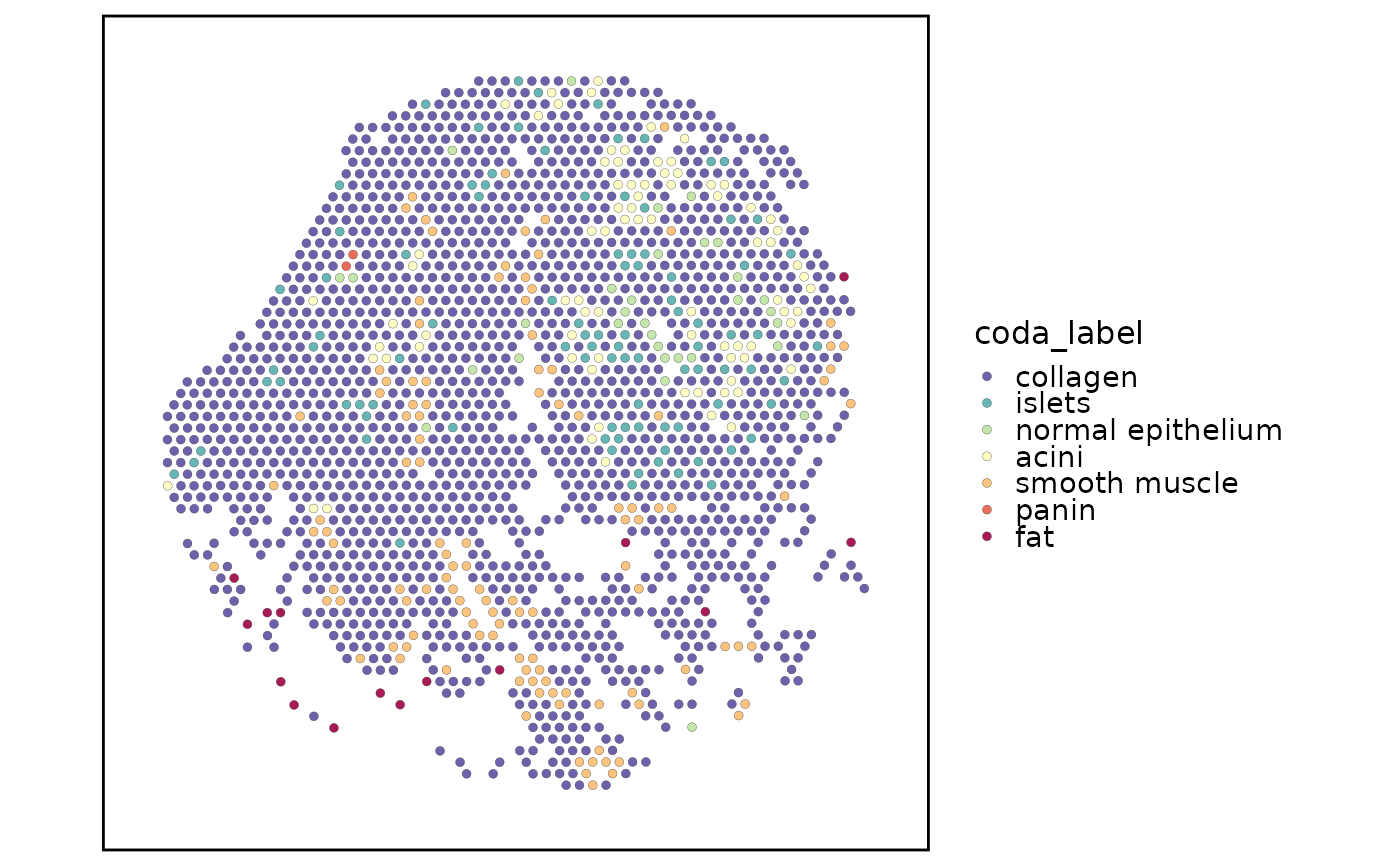 spatial <- RunSemlaSpatialNetwork(
spatial,
nNeighbors = 6,
coords = "pixels",
verbose = FALSE
)
#> ℹ Found VisiumV2 object(s).
#>
#> ── Collecting data from @images slot
#> ! Array coordinates are not available for non-VisiumHD datasets. Please consider using semla's own functions to load the data. See '?ReadVisiumData()'
spatial <- RunSemlaSpatialNetwork(
spatial,
nNeighbors = 6,
coords = "pixels",
verbose = FALSE
)
#> ℹ Found VisiumV2 object(s).
#>
#> ── Collecting data from @images slot
#> ! Array coordinates are not available for non-VisiumHD datasets. Please consider using semla's own functions to load the data. See '?ReadVisiumData()'