Use semla::RunLocalG() on a Staffli-enabled Seurat object. Results are
written by semla to metadata or to an assay, depending on
store_in_metadata.
SCOP provides no dedicated plot for this result; retrieve its schema record
with GetSpatialResult() and inspect the recorded output columns or assay.
Usage
RunSemlaLocalG(
  srt,
  features,
  alternative = NULL,
  store_in_metadata = TRUE,
  assay_name = "GiScores",
  image_type = "tissue_lowres",
  verbose = TRUE,
  ...
)
Arguments
- srt
A
Seuratobject with spatial image data.- features
Features passed to
semla::RunLocalG().- alternative
Alternative hypothesis passed to semla. Use
NULLto keep semla's default behavior.- store_in_metadata
Whether semla should store results in metadata.
- assay_name
Assay name used by semla when
store_in_metadata = FALSE.- image_type
Image scale used by
semla::UpdateSeuratForSemla()when the object does not already contain a Staffli object.- verbose
Whether to print the message. Default is
TRUE.- ...
Additional arguments passed to semla.
Examples
data(visium_human_pancreas_sub)
spatial <- visium_human_pancreas_sub
spatial <- Seurat::NormalizeData(spatial, assay = "Spatial", verbose = FALSE)
features <- rownames(spatial)[1:3]
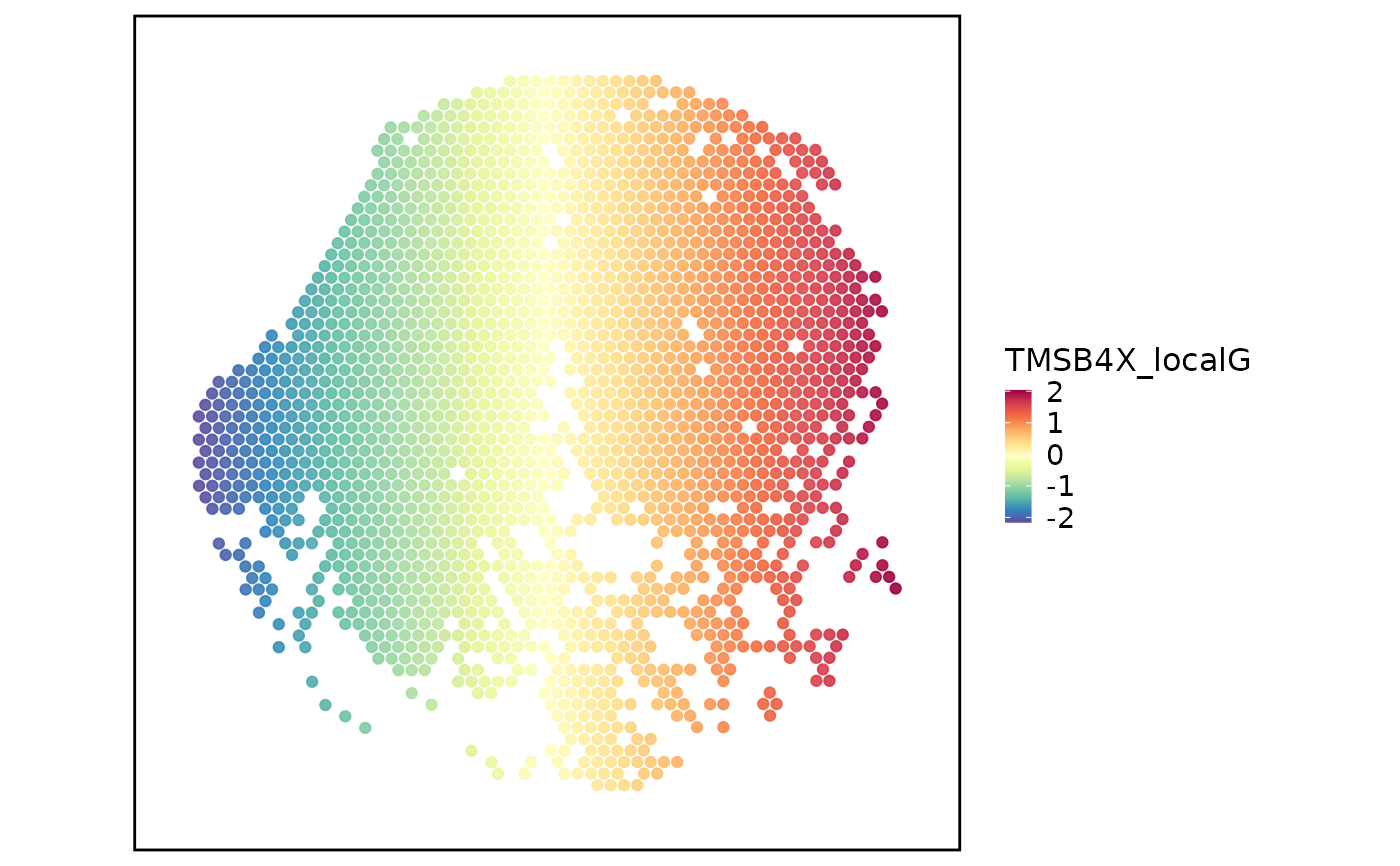
spatial[[paste0(features[1], "_localG")]] <- as.numeric(scale(spatial$x))
SpatialSpotPlot(
spatial,
group.by = paste0(features[1], "_localG"),
overlay_image = FALSE,
coord.cols = c("x", "y")
)
 spatial <- RunSemlaLocalG(
spatial,
features = features,
store_in_metadata = TRUE,
verbose = FALSE
)
#> ℹ Found VisiumV2 object(s).
#>
#> ── Collecting data from @images slot
#> ! Array coordinates are not available for non-VisiumHD datasets. Please consider using semla's own functions to load the data. See '?ReadVisiumData()'
spatial <- RunSemlaLocalG(
spatial,
features = features,
store_in_metadata = TRUE,
verbose = FALSE
)
#> ℹ Found VisiumV2 object(s).
#>
#> ── Collecting data from @images slot
#> ! Array coordinates are not available for non-VisiumHD datasets. Please consider using semla's own functions to load the data. See '?ReadVisiumData()'