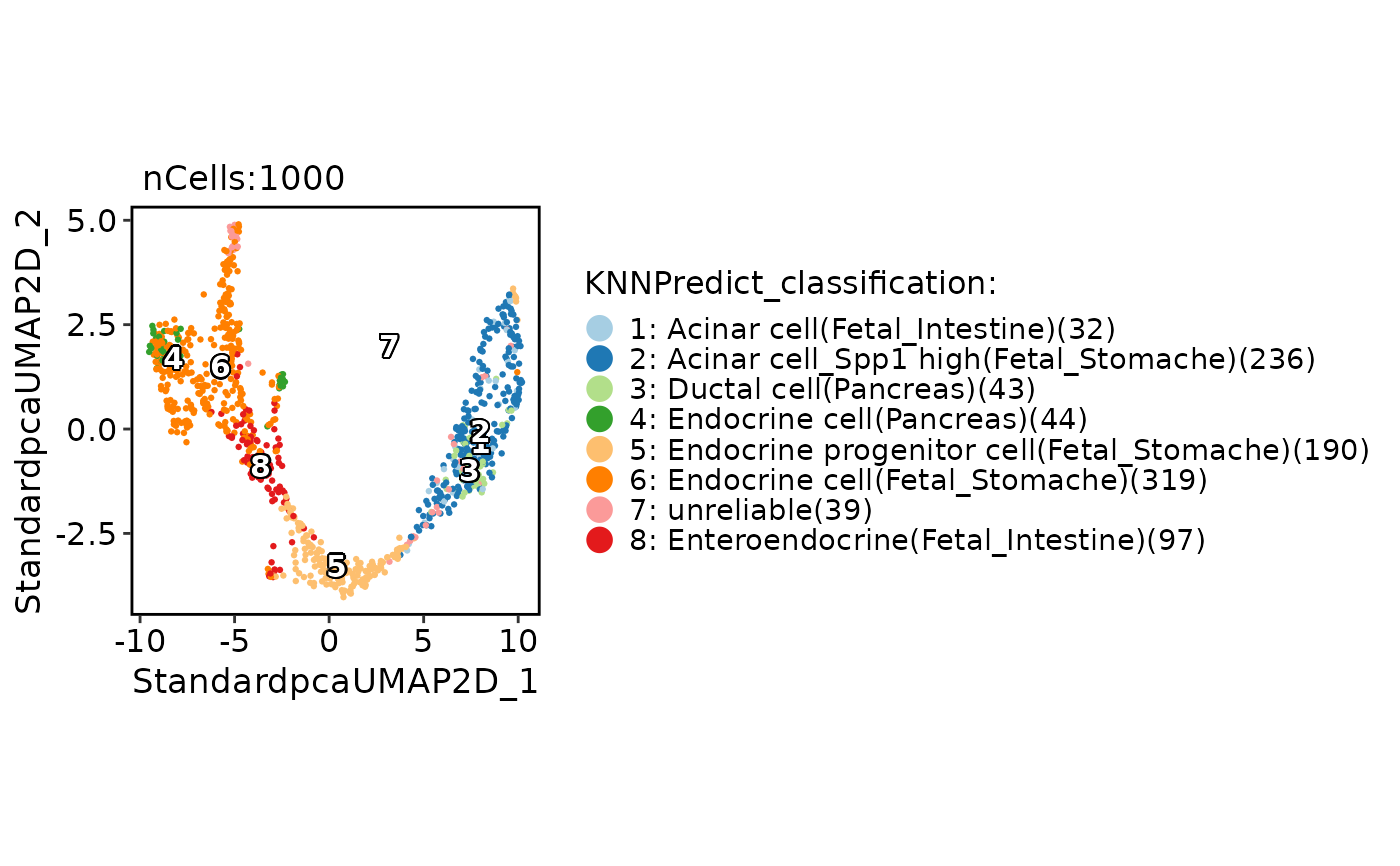
Performs KNN prediction to annotate cell types based on reference scRNA-seq or bulk RNA-seq data.
Usage
RunKNNPredict(
  srt_query,
  srt_ref = NULL,
  bulk_ref = NULL,
  query_group = NULL,
  ref_group = NULL,
  query_assay = NULL,
  ref_assay = NULL,
  query_reduction = NULL,
  ref_reduction = NULL,
  query_dims = 1:30,
  ref_dims = 1:30,
  query_collapsing = !is.null(query_group),
  ref_collapsing = TRUE,
  return_full_distance_matrix = FALSE,
  features = NULL,
  features_type = c("HVF", "DE"),
  feature_source = "both",
  nfeatures = 2000,
  DEtest_param = list(max.cells.per.ident = 200, test.use = "wilcox"),
  DE_threshold = "p_val_adj < 0.05",
  nn_method = NULL,
  distance_metric = "cosine",
  k = 30,
  filter_lowfreq = 0,
  prefix = "KNNPredict",
  verbose = TRUE
)
Arguments
- srt_query
An object of class Seurat to be annotated with cell types.
- srt_ref
An object of class Seurat storing the reference cells.
- bulk_ref
A cell atlas matrix, where cell types are represented by columns and genes are represented by rows. Either
srt_reforbulk_refmust be provided.- query_group
Column name in the
srt_querymetadata that represents the cell grouping.- ref_group
Column name in the
srt_refmetadata that represents the cell grouping.- query_assay
Assay to be used for the query data. Default is the default assay of the
srt_queryobject.- ref_assay
Assay to be used for the reference data. Default is the default assay of the
srt_refobject.- query_reduction
Dimensionality reduction method used for the query data. If NULL, the function will use the default reduction method specified in the
srt_queryobject.- ref_reduction
Dimensionality reduction method used for the reference data. If NULL, the function will use the default reduction method specified in the
srt_refobject.- query_dims
Dimensions to be used for the query data. Default is the first
30dimensions.- ref_dims
Dimensions to be used for the reference data. Default is the first
30dimensions.- query_collapsing
A boolean value indicating whether the query data should be collapsed to group-level average expression values. If TRUE, the function will calculate the average expression values for each group in the query data and the annotation will be performed separately for each group. Otherwise it will use the raw expression values for each cell.
- ref_collapsing
A boolean value indicating whether the reference data should be collapsed to group-level average expression values. If TRUE, the function will calculate the average expression values for each group in the reference data and the annotation will be performed separately for each group. Otherwise it will use the raw expression values for each cell.
- return_full_distance_matrix
A boolean value indicating whether the full distance matrix should be returned. If TRUE, the function will return the distance matrix used for the KNN prediction, otherwise it will only return the annotated cell types.
- features
Features to be used for the KNN prediction. If
NULL, all the features in the query and reference data will be used.- features_type
Type of features to be used for the KNN prediction. Must be one of "HVF" (highly variable features) or "DE" (differentially expressed features).
- feature_source
The source of the features to be used. Must be one of "both", "query", or "ref".
- nfeatures
Maximum number of features to be used for the KNN prediction.
- DEtest_param
A list of parameters to be passed to the differential expression test function if
features_typeis set to "DE". Default islist(max.cells.per.ident = 200, test.use = "wilcox").- DE_threshold
Threshold used to filter the DE features. If using "roc" test,
DE_thresholdshould be needs to be reassigned. e.g. "power > 0.5".- nn_method
Nearest neighbor search method to use. Options are "raw", "annoy", and "rann". If "raw" is selected, the function will use the brute-force method to find the nearest neighbors. If "annoy" is selected, the function will use the Annoy library for approximate nearest neighbor search. If "rann" is selected, the function will use the RANN library for approximate nearest neighbor search. If not provided, the function will choose the search method based on the size of the query and reference datasets. For finite dense inputs using cosine or Euclidean distance, the raw path uses a bounded-memory compiled top-k kernel unless the full distance matrix is requested. Other metrics and sparse inputs retain the existing proxyC path.
- distance_metric
Distance metric to be used for calculating similarity between cells. Must be one of "cosine", "euclidean", "manhattan", or "hamming".
- k
A number of nearest neighbors to be considered for the KNN prediction.
- filter_lowfreq
Threshold for filtering low-frequency cell types from the predicted results. Cell types with a frequency lower than
filter_lowfreqwill be labelled as "unreliable". Default is0, which means no filtering will be performed.- prefix
Prefix to be added to the resulting annotations.
- verbose
Whether to print the message. Default is
TRUE.
Examples
data(panc8_sub)
keep <- panc8_sub$celltype %in% c("ductal", "alpha", "beta")
reference <- Seurat::NormalizeData(
panc8_sub[, keep & panc8_sub$tech != "fluidigmc1"],
verbose = FALSE
)
query <- Seurat::NormalizeData(
panc8_sub[, keep & panc8_sub$tech == "fluidigmc1"],
verbose = FALSE
)
genes <- head(intersect(rownames(reference), rownames(query)), 200)
query <- RunKNNPredict(
query,
srt_ref = reference, ref_group = "celltype",
features = genes, nfeatures = length(genes),
ref_collapsing = FALSE, k = 10, verbose = FALSE
)
query <- RunStandardWorkflow(query, verbose = FALSE, linear_reduction_dims = 10)
#> ℹ [2026-10-11 23:39:10] Skip `log1p()` because `layer = data` is not "counts"
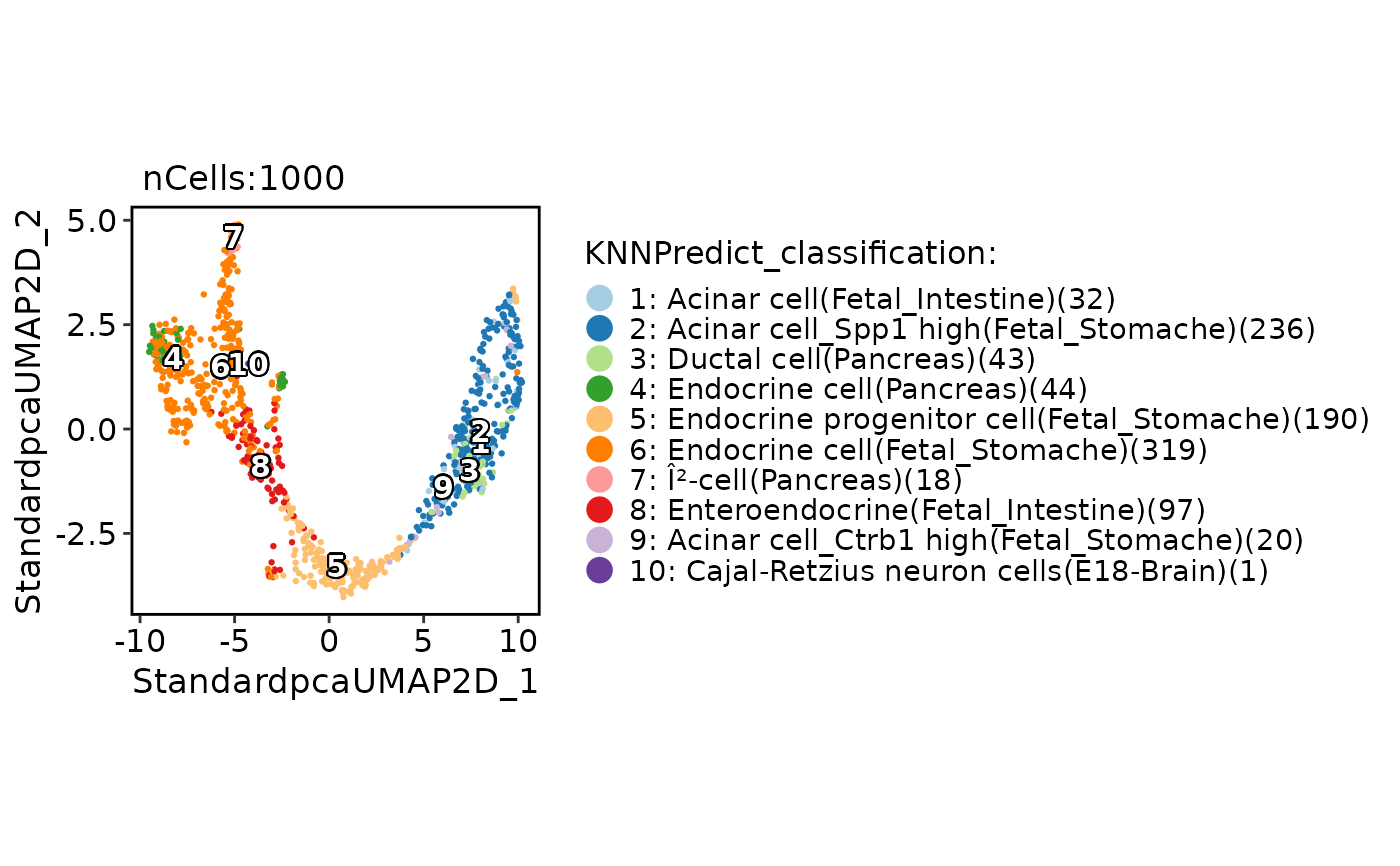
CellDimPlot(
query,
group.by = "KNNPredict_classification",
label = TRUE, legend.position = "bottom"
)
 FeatureStatPlot(
query,
stat.by = "KNNPredict_prob",
group.by = "KNNPredict_classification",
plot_type = "box"
)
FeatureStatPlot(
query,
stat.by = "KNNPredict_prob",
group.by = "KNNPredict_classification",
plot_type = "box"
)