RareQ rare-cell population detection
Usage
RunRareQ(
  object,
  assay = NULL,
  reduction = "pca",
  dims = 1:30,
  k.param = 20,
  k = 6,
  Q_cut = 0.6,
  ratio = 0.2,
  max_iter = 100,
  run_neighbors = TRUE,
  force_recalc = FALSE,
  neighbor_name = NULL,
  find_neighbors_params = list(),
  rare_threshold = 0.01,
  prefix = "RareQ",
  cluster_colname = paste0(prefix, "_cluster"),
  q_colname = paste0(prefix, "_Q"),
  size_colname = paste0(prefix, "_cluster_size"),
  rare_colname = paste0(prefix, "_is_rare"),
  tool_name = "RareQ",
  verbose = TRUE,
  srt = NULL
)
Arguments
- object
A
Seuratobject.- assay
Assay to use.
NULLuses the default assay.- reduction
Reduction used to build nearest neighbors when the required
{assay}.nnneighbor slot is absent orforce_recalc = TRUE. IfNULL,DefaultReduction()is used.- dims
Dimensions from
reductionused for nearest-neighbor search.- k.param
Number of nearest neighbors to compute with
Seurat::FindNeighbors()when neighbor search is needed.- k
Number of nearest neighbors used by RareQ to compute Q values.
- Q_cut
Q-value threshold passed to
RareQ::FindRare().- ratio
Merge-ratio threshold passed to
RareQ::FindRare().- max_iter
Maximum number of RareQ propagation iterations.
- run_neighbors
Whether to build the required Seurat neighbor slot if it is missing.
- force_recalc
Whether to rebuild the Seurat neighbor slot before running RareQ.
- neighbor_name
Name of the Seurat
Neighborobject to reuse or create. IfNULL, defaults to{assay}.nn, which is the neighbor slot required byRareQ::ComputeQ()andRareQ::FindRare(). A non-default neighbor is copied to{assay}.nnbefore running RareQ because RareQ reads that slot directly.- find_neighbors_params
Additional named parameters passed to
Seurat::FindNeighbors()when neighbor search is run.- rare_threshold
Cluster-size threshold used to mark rare clusters. A value smaller than 1 is treated as a fraction of cells; a value of 1 or larger is treated as a cell count. Set to
NULLto skip rare flags.- prefix
Prefix used for metadata columns.
- cluster_colname, q_colname, size_colname, rare_colname
Metadata column names for RareQ clusters, Q values, cluster sizes, and rare-cluster flags.
- tool_name
Name of the
srt@toolsentry.- verbose
Whether to print the message. Default is
TRUE.- srt
Deprecated alias for
object; supply exactly one of the two. It will be removed in scop 1.0.0.
Details
Stored results retain a private per-cell identity metadata column for
GetSpatialResult(). Preserve this column when subsetting or renaming cells.
The accessor returns current-cell assignments; stored native results and
fit parameters remain unchanged.
References
Fa B, Huang C, Ma Y, et al. (2026). Cell neighborhood topology directs rare cell population identification. Nature Communications, 17, 4618. doi:10.1038/s41467-026-71180-x
Examples
data(pancreas_sub)
pancreas_sub <- RunStandardWorkflow(
pancreas_sub,
verbose = FALSE
)
#> ℹ [2026-10-11 23:44:13] Skip `log1p()` because `layer = data` is not "counts"
pancreas_sub <- RunRareQ(
pancreas_sub,
dims = 1:20
)
#> ℹ [2026-10-11 23:44:54] Build Seurat nearest neighbors for RareQ using reduction "Standardpca"
#> Computing nearest neighbors
#> ℹ [2026-10-11 23:44:55] Only one graph name supplied, storing nearest-neighbor graph only
#> ℹ [2026-10-11 23:45:18] Run RareQ with `k = 6`, `Q_cut = 0.6`, and `ratio = 0.2`
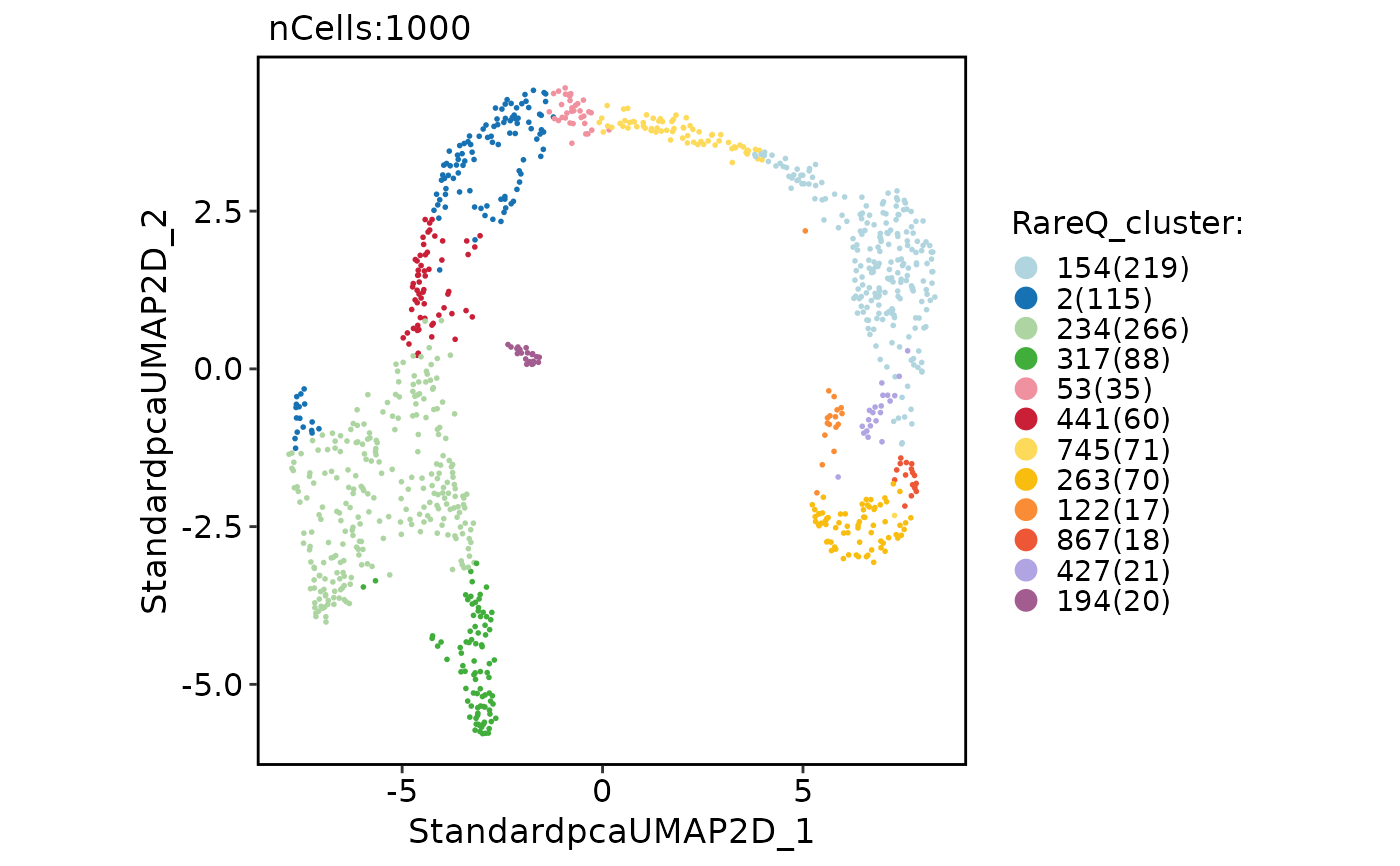
#> ℹ [2026-10-11 23:45:18] RareQ clusters stored in metadata column "RareQ_cluster"
CellDimPlot(
pancreas_sub,
group.by = "RareQ_cluster"
)
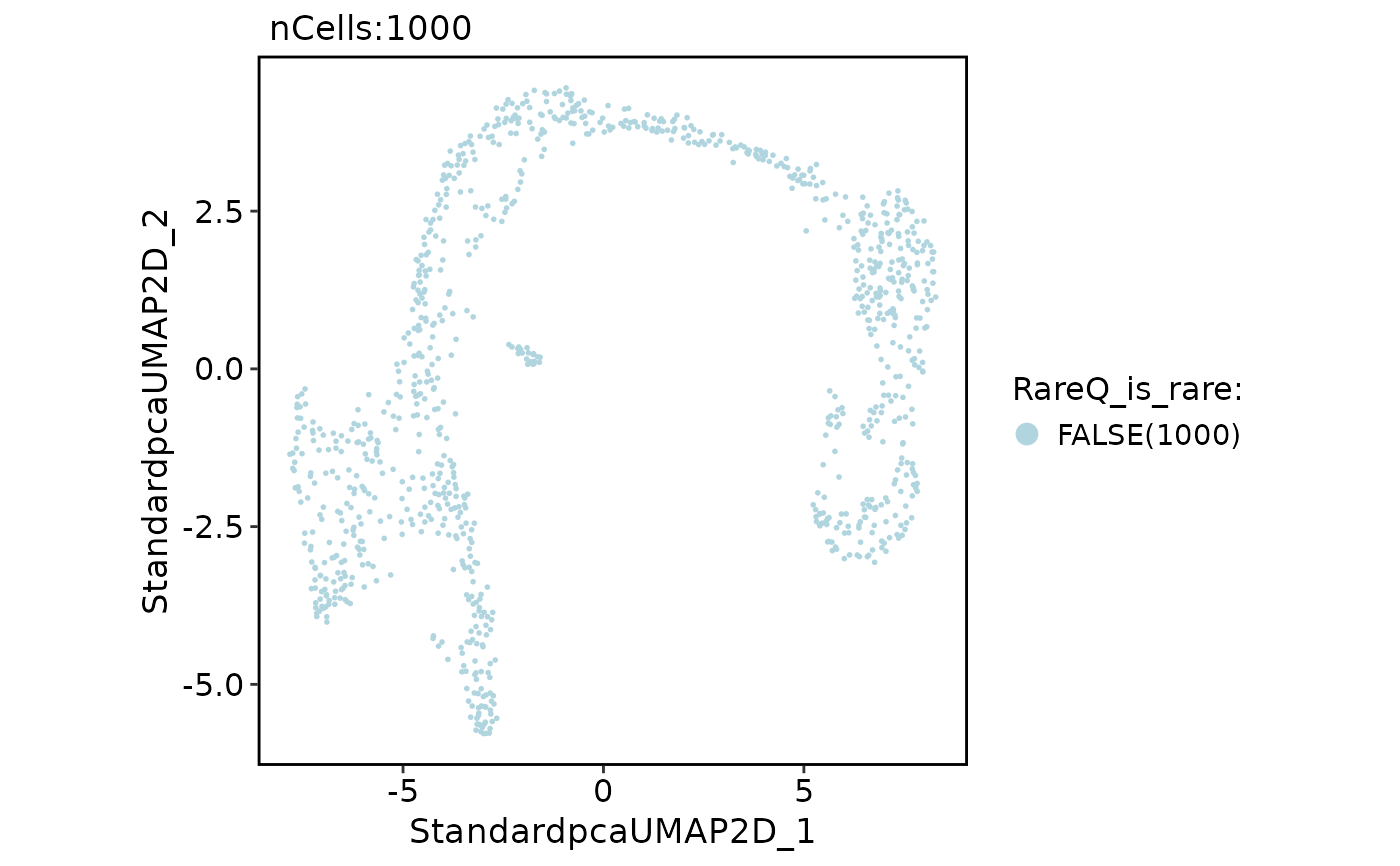
 CellDimPlot(
pancreas_sub,
group.by = "RareQ_is_rare"
)
CellDimPlot(
pancreas_sub,
group.by = "RareQ_is_rare"
)
 FeatureDimPlot(
pancreas_sub,
features = "RareQ_Q"
)
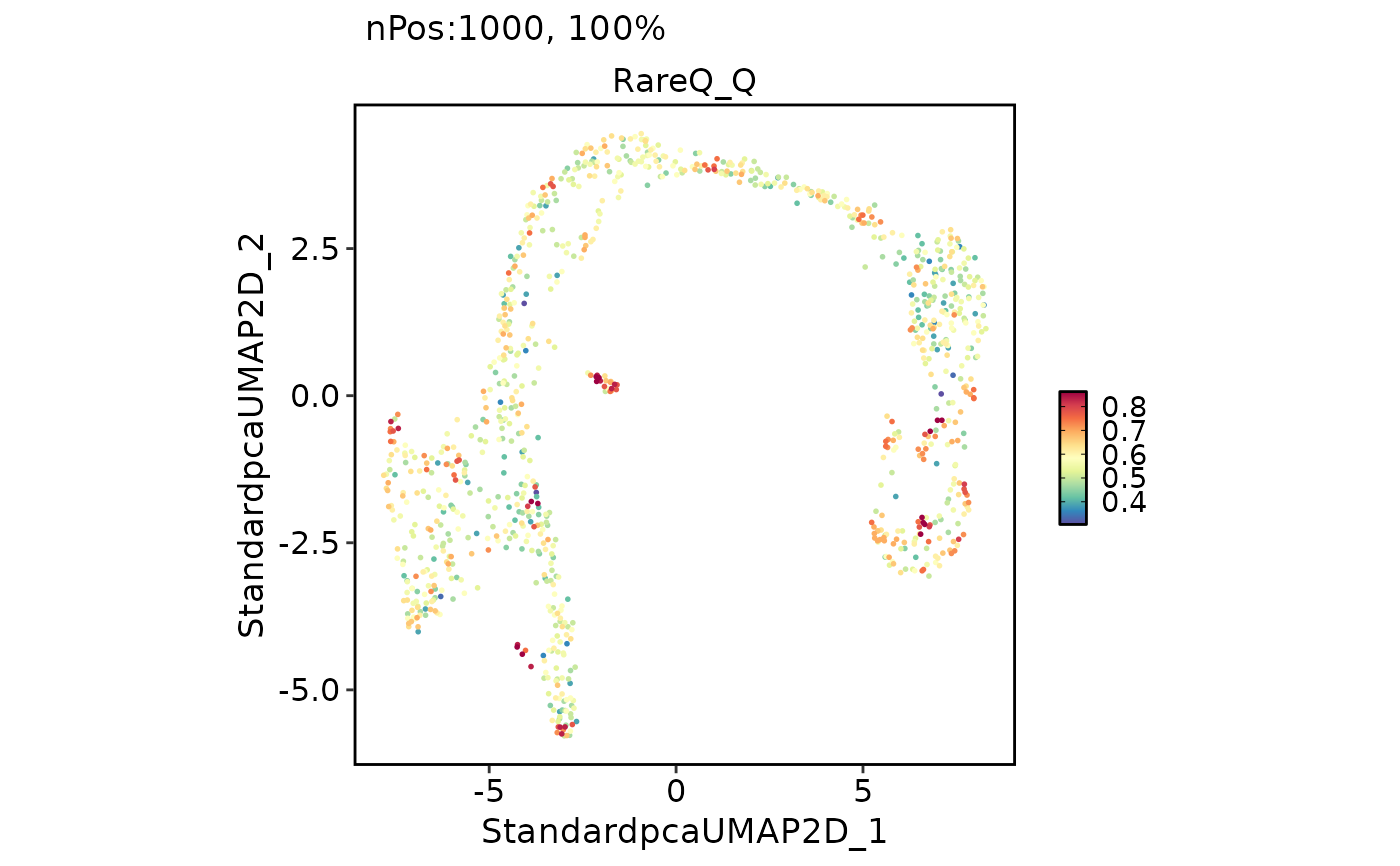
FeatureDimPlot(
pancreas_sub,
features = "RareQ_Q"
)