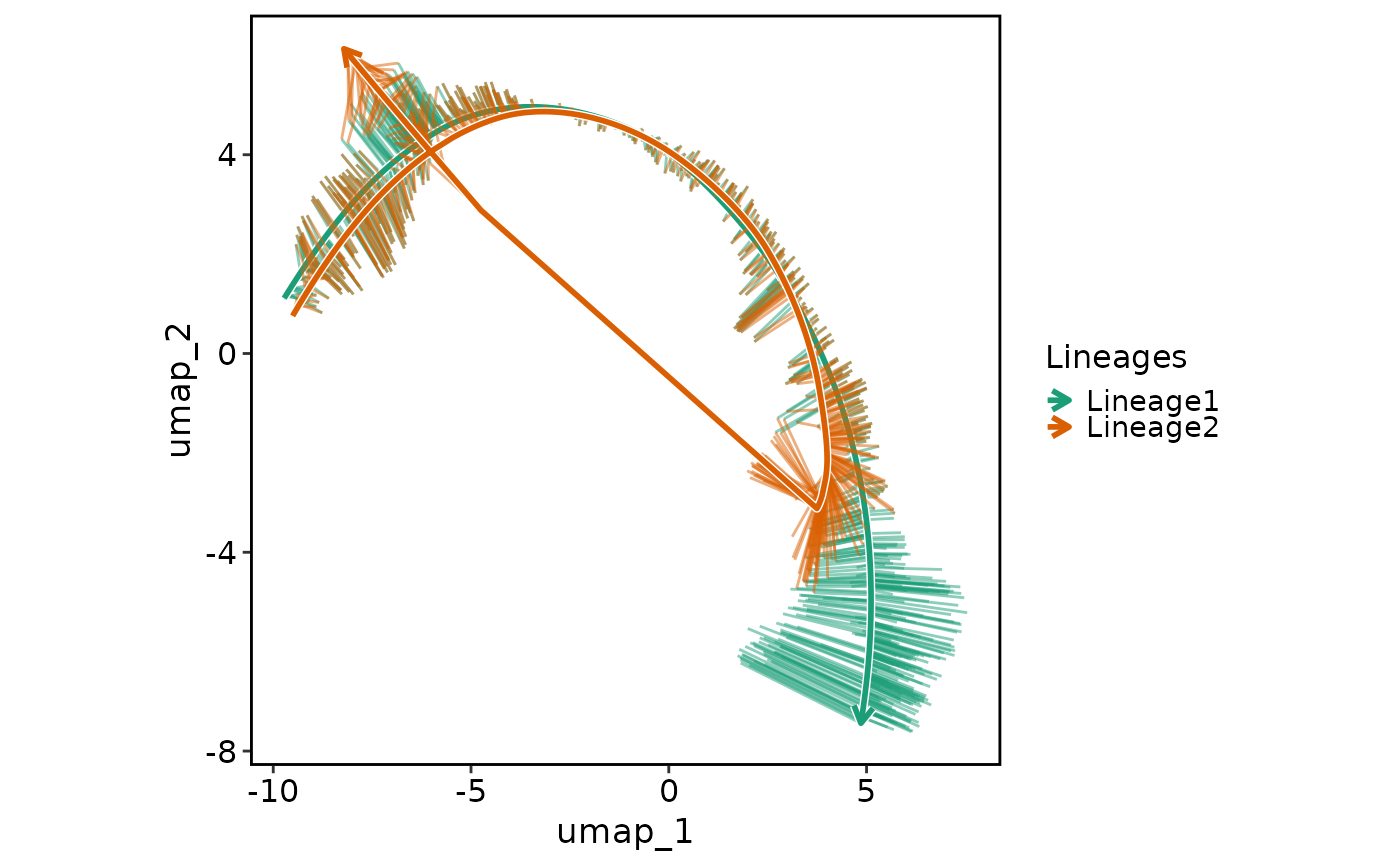
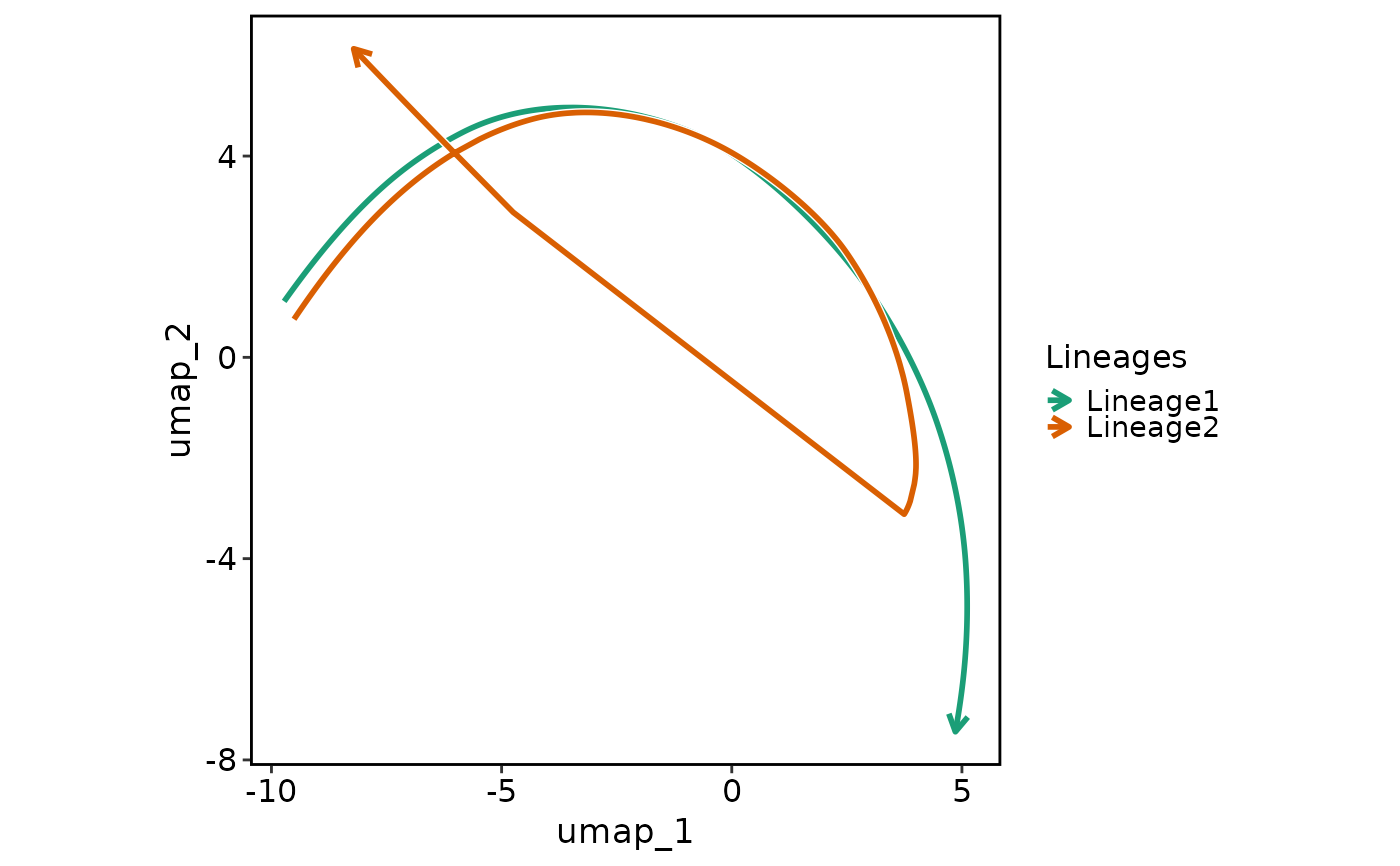
Generate a lineage plot based on the pseudotime.
Usage
LineagePlot(
  object,
  lineages,
  reduction = NULL,
  dims = c(1, 2),
  cells = NULL,
  trim = c(0.01, 0.99),
  span = 0.75,
  palette = "Dark2",
  palcolor = NULL,
  lineages_arrow = grid::arrow(length = grid::unit(0.1, "inches")),
  linewidth = 1,
  line_bg = "white",
  line_bg_stroke = 0.5,
  whiskers = FALSE,
  whiskers_linewidth = 0.5,
  whiskers_alpha = 0.5,
  aspect.ratio = 1,
  title = NULL,
  subtitle = NULL,
  xlab = NULL,
  ylab = NULL,
  legend.position = "right",
  legend.direction = "vertical",
  theme_use = "theme_scop",
  theme_args = list(),
  return_layer = FALSE,
  seed = 11,
  verbose = TRUE,
  srt = NULL
)
Arguments
- object
A
Seuratobject.- lineages
A character vector that specifies the lineages to be included. Typically, use the pseudotime of cells.
- reduction
Reduction to plot.
NULLuses DefaultReduction.- dims
Length-2 vector of dimensions to plot.
- cells
Cell names to include.
- trim
A numeric vector of length 2 specifying the quantile range of lineages to include in the plot.
- span
The span of the loess smoother.
- palette
Color palette name. Available palettes can be found in thisplot::show_palettes.
- palcolor
Custom colors used to create a color palette.
- lineages_arrow
An arrow object specifying the arrow for lineages.
- linewidth
The linewidth for the lineages.
- line_bg
Color for the background lines.
- line_bg_stroke
The stroke width for the background lines.
- whiskers
Whether to include whiskers in the plot.
- whiskers_linewidth
The linewidth for the whiskers.
- whiskers_alpha
The transparency for the whiskers.
- aspect.ratio
Panel aspect ratio.
- title, subtitle, xlab, ylab
Plot labels.
- legend.position
Legend position passed to
theme().- legend.direction
Legend direction passed to
theme().- theme_use, theme_args
Theme name or function, plus extra theme arguments.
- return_layer
Whether to return the plot layers as a list. Defaults is
FALSE.- seed
Random seed.
- verbose
Whether to print messages.
- srt
Deprecated alias for
object; supply exactly one of the two. It will be removed in scop 1.0.0.
Examples
data(pancreas_sub)
pancreas_sub <- RunStandardWorkflow(pancreas_sub)
#> ℹ [2026-10-11 22:59:57] Start standard processing workflow...
#> ℹ [2026-10-11 22:59:57] Checking a list of <Seurat>...
#> ! [2026-10-11 22:59:57] Data 1/1 of the `srt_list` is "unknown"
#> ℹ [2026-10-11 22:59:57] Perform `NormalizeData()` with `normalization.method = 'LogNormalize'` on 1/1 of `srt_list`...
#> ℹ [2026-10-11 22:59:57] Perform `FindVariableFeatures()` on 1/1 of `srt_list`...
#> ℹ [2026-10-11 22:59:57] Use the separate HVF from `srt_list`
#> ℹ [2026-10-11 22:59:57] Number of available HVF: 2000
#> ℹ [2026-10-11 22:59:57] Finished check
#> ℹ [2026-10-11 22:59:57] Perform `ScaleData()`
#> ℹ [2026-10-11 22:59:57] Perform pca linear dimension reduction
#> ℹ [2026-10-11 22:59:58] Use stored estimated dimensions 1:23 for Standardpca
#> ℹ [2026-10-11 22:59:58] Perform `Seurat::FindClusters()` with `cluster_algorithm = 'louvain'` and `cluster_resolution = 0.6`
#> ℹ [2026-10-11 22:59:58] Reorder clusters...
#> ℹ [2026-10-11 22:59:58] Skip `log1p()` because `layer = data` is not "counts"
#> ℹ [2026-10-11 22:59:58] Perform umap nonlinear dimension reduction
#> ✔ [2026-10-11 23:00:04] Standard processing workflow completed
pancreas_sub <- RunSlingshot(
pancreas_sub,
group.by = "SubCellType",
reduction = "UMAP",
show_plot = FALSE
)
LineagePlot(
pancreas_sub,
lineages = paste0("Lineage", 1:2)
)
 LineagePlot(
pancreas_sub,
lineages = paste0("Lineage", 1:2),
whiskers = TRUE
)
LineagePlot(
pancreas_sub,
lineages = paste0("Lineage", 1:2),
whiskers = TRUE
)