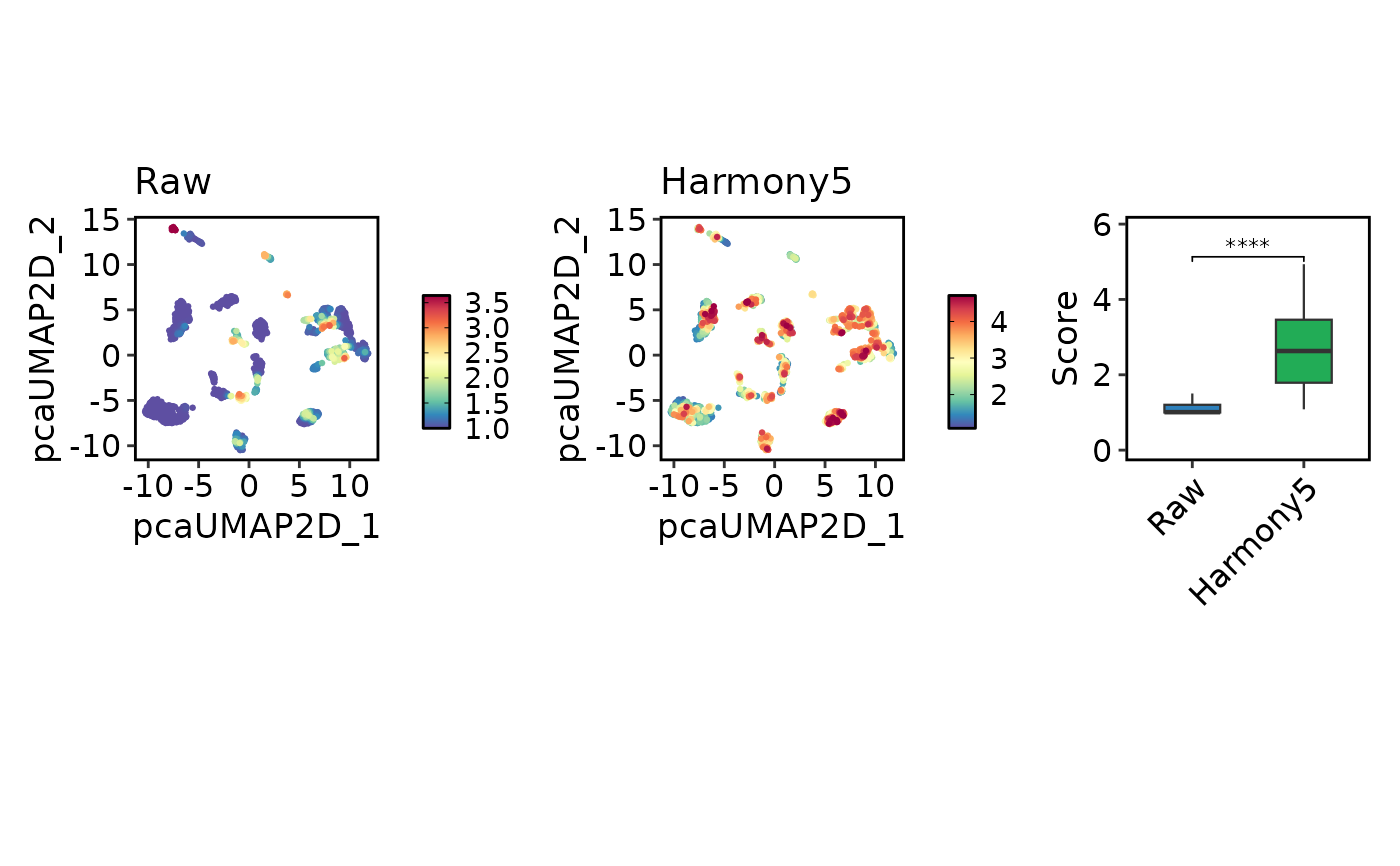
Compute per-cell Local Inverse Simpson's Index (LISI) scores from a
dimensional reduction and store them in the meta.data and tools slots
of a Seurat object.
Usage
RunLISI(
  object,
  reductions = NULL,
  reduction = NULL,
  dims = NULL,
  label_colnames = NULL,
  prefix = NULL,
  tool_name = NULL,
  perplexity = 30,
  tol = 1e-05,
  max_iter = 50,
  knn_algorithm = c("auto", "brute_force", "clustered"),
  cores = NULL,
  max_dense_bytes = Inf,
  overwrite = TRUE,
  verbose = TRUE,
  srt = NULL
)
Arguments
- object
A
Seuratobject.- reductions
Character vector of dimensional reductions used to compute LISI. If
NULL,DefaultReduction()is used.- reduction
Deprecated alias of
reductions.- dims
Dimensions to use from the reduction. Default is
NULL, which uses all available dimensions.- label_colnames
Character vector of metadata columns used for LISI. If
NULL,RunLISI()will try to usesrt@misc[["integration_batch"]].- prefix
Prefix used for the stored LISI metadata columns. If
NULL, the reduction names are used.- tool_name
Name used to store detailed results in
srt@tools. Default is"LISI"when multiple reductions are provided, otherwisepaste0(prefix, "_LISI").- perplexity
Effective neighborhood size.
- tol
Tolerance used in the binary search for the target perplexity.
- max_iter
Maximum number of binary-search iterations.
- knn_algorithm
Exact nearest-neighbor strategy passed to
thisutils::compute_lisi().- cores
Number of LISI C++ worker threads.
NULL(the default) letsthisutils::compute_lisi()select the available hardware threads.- max_dense_bytes
Maximum estimated bytes allowed for LISI's dense input and C++ copy. Default is
Inf, which preserves unrestricted behavior.- overwrite
Whether to overwrite existing metadata columns.
- verbose
Whether to print the message. Default is
TRUE.- srt
Deprecated alias for
object; supply exactly one of the two. It will be removed in scop 1.0.0.
Examples
data(panc8_sub)
set.seed(1)
demo_embedding <- matrix(
  stats::rnorm(ncol(panc8_sub) * 5),
  nrow = ncol(panc8_sub),
  dimnames = list(colnames(panc8_sub), paste0("DEMO_", 1:5))
)
panc8_sub[["demo"]] <- SeuratObject::CreateDimReducObject(
  embeddings = demo_embedding,
  key = "DEMO_",
  assay = SeuratObject::DefaultAssay(panc8_sub)
)
names(panc8_sub@reductions)
#> [1] "demo"

panc8_sub <- RunLISI(
  panc8_sub,
  reductions = "demo",
  label_colnames = "tech",
  perplexity = 10
)
#> ℹ [2026-10-11 23:39:18] Compute LISI scores from reduction "demo"
#> ✔ [2026-10-11 23:39:19] Stored LISI scores in metadata: "demo_tech_LISI"
IntegrationBenchmarkPlot(panc8_sub, plot_type = "box")