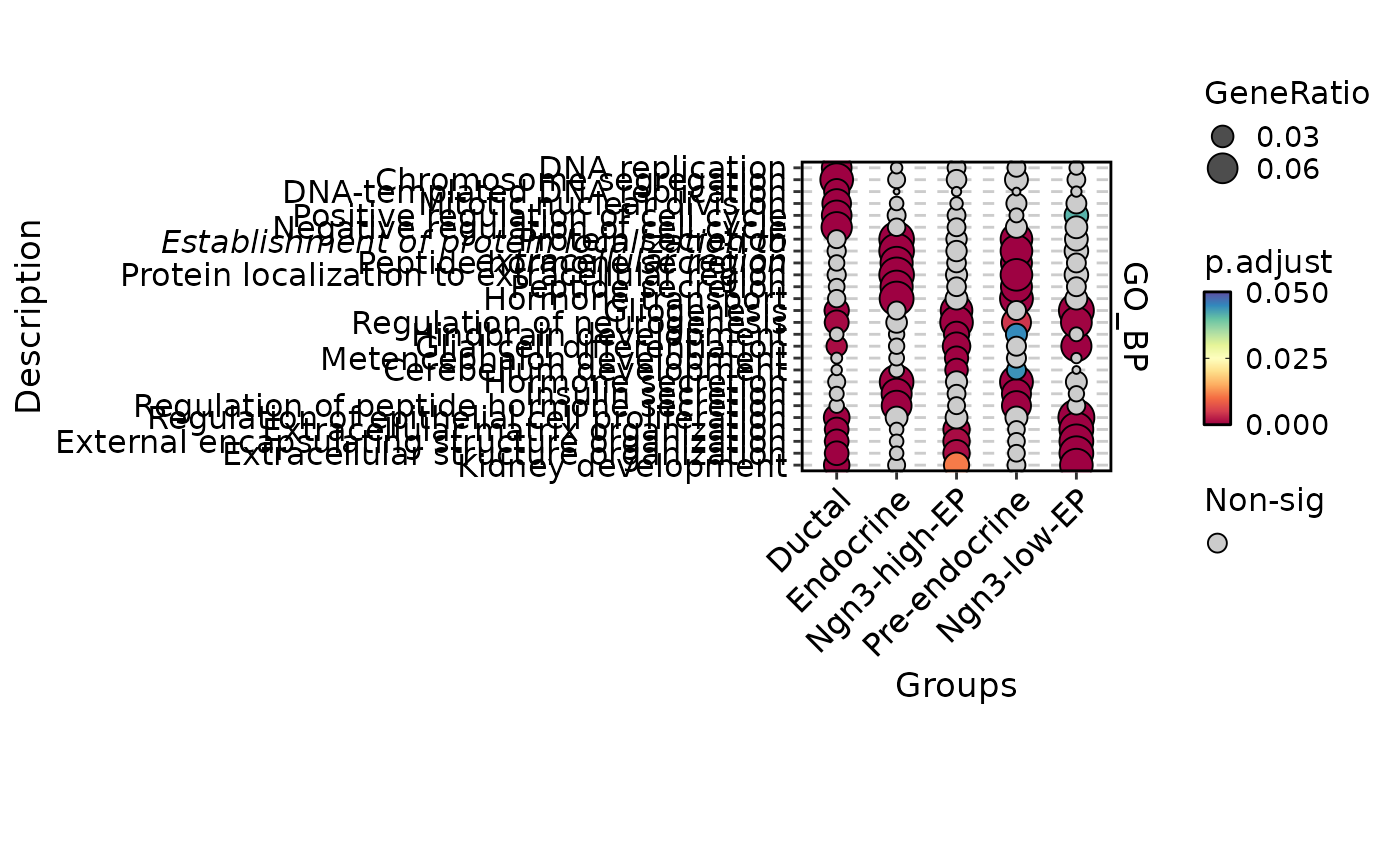
Perform the enrichment analysis (over-representation) on the genes
Source:R/RunEnrichment.R
RunEnrichment.RdPerform the enrichment analysis (over-representation) on the genes
Usage
RunEnrichment(
  object = NULL,
  group.by = NULL,
  test.use = "wilcox",
  DE_threshold = "avg_log2FC > 0 & p_val_adj < 0.05",
  geneID = NULL,
  geneID_groups = NULL,
  geneID_exclude = NULL,
  IDtype = "symbol",
  result_IDtype = "symbol",
  backend = c("cpp", "r"),
  species = "Homo_sapiens",
  db = "GO_BP",
  db_update = FALSE,
  db_version = "latest",
  db_combine = FALSE,
  convert_species = TRUE,
  Ensembl_version = NULL,
  mirror = NULL,
  features = NULL,
  TERM2GENE = NULL,
  TERM2NAME = NULL,
  minGSSize = 10,
  maxGSSize = 500,
  unlimited_db = c("Chromosome", "GeneType", "TF", "Enzyme", "CSPA"),
  GO_simplify = FALSE,
  GO_simplify_cutoff = "p.adjust < 0.05",
  simplify_method = "Wang",
  simplify_similarityCutoff = 0.7,
  verbose = TRUE,
  ...,
  srt = NULL
)
Arguments
- object
A
Seuratobject orSummarizedExperimentobject containing the results of differential expression analysis (RunDEtest()). If specified, the genes and groups will be extracted from the object automatically. If not specified, thegeneIDandgeneID_groupsarguments must be provided.- group.by
Metadata column(s) used to color cells.
- test.use
Test to be used in differential expression analysis. This argument is only used if
objectis specified.- DE_threshold
Filter condition for differential expression analysis. This argument is only used if
objectis specified.- geneID
Gene IDs.
- geneID_groups
A factor vector specifying the group labels for each gene.
- geneID_exclude
Gene IDs to be excluded from the analysis.
- IDtype
Type of gene IDs in the
objectobject orgeneIDargument. This argument is used to convert the gene IDs to a different type ifIDtypeis different fromresult_IDtype.- result_IDtype
Desired type of gene ID to be used in the output. This argument is used to convert the gene IDs from
IDtypetoresult_IDtype.- backend
Enrichment backend.
"cpp"is the default and uses a fast native hypergeometric ORA implementation and returns the enrichment table withoutenrichResultobjects."r"usesclusterProfiler::enricher()and returnsenrichResultobjects inresults.GO_simplify = TRUEcurrently uses the R backend.- species
"Homo_sapiens"or"Mus_musculus".- db
Character vector of database or resource selectors:
"GO","GO_BP","GO_CC","GO_MF","KEGG","WikiPathway","Reactome","CORUM","MP","DO","HPO","PFAM","Chromosome","GeneType","Enzyme","TF","CSPA","Surfaceome","SPRomeDB","VerSeDa","TFLink","hTFtarget","TRRUST","JASPAR","ENCODE","MSigDB","CellTalk","CellChat","CytoTRACE2"or"MSigDB_<collection>". A vector may combine sources. See the corresponding preparation function for source-specific settings.- db_update
Force a refresh.
FALSEloads the cache when available.- db_version
Database version to retrieve.
- db_combine
Whether to combine multiple databases into one. If
TRUE, all database specified bydbwill be combined as one named "Combined".- convert_species
Use a species-converted database when the annotation is missing for
species.- Ensembl_version
Ensembl version.
NULLuses the latest.- mirror
Specify an Ensembl mirror to connect to. The valid options here are
"www","uswest","useast","asia".- features
A named list of feature lists for custom enrichment gene sets. If provided, it takes precedence over
TERM2GENEanddb.- TERM2GENE
A data frame specifying the gene-term mapping for a custom database. The first column should contain the term IDs, and the second column should contain the gene IDs.
- TERM2NAME
A data frame specifying the term-name mapping for a custom database. The first column should contain the term IDs, and the second column should contain the corresponding term names.
- minGSSize
The minimum size of a gene set to be considered in the enrichment analysis.
- maxGSSize
The maximum size of a gene set to be considered in the enrichment analysis.
- unlimited_db
Names of databases that do not have size restrictions.
- GO_simplify
Whether to simplify the GO terms. If
TRUE, additional results with simplified GO terms will be returned.- GO_simplify_cutoff
Filter condition for simplification of GO terms. This argument is only used if
GO_simplifyisTRUE.- simplify_method
Method to be used for simplification of GO terms. This argument is only used if
GO_simplifyisTRUE.- simplify_similarityCutoff
The similarity cutoff for simplification of GO terms. This argument is only used if
GO_simplifyisTRUE.- verbose
Whether to print the message. Default is
TRUE.- ...
Passed to helper functions.
- srt
Deprecated alias for
object; supply exactly one of the two. It will be removed in scop 1.0.0.
Value
If input is a Seurat object, returns the modified Seurat object with the enrichment result stored in the tools slot.
If input is a geneID vector with or without geneID_groups, return the enrichment result directly.
Enrichment result is a list with the following component:
enrichment: A data.frame containing all enrichment results.results: A list ofenrichResultobjects from the DOSE package.geneMap: A data.frame containing the ID mapping table for input gene IDs.input: A data.frame containing the input gene IDs and gene ID groups.DE_threshold: A specific threshold for differential expression analysis (only returned if input is a Seurat object).
Examples
term2gene <- data.frame(
  Term = c(
    rep("Endocrine markers", 5),
    rep("Exocrine markers", 5),
    rep("Ductal markers", 5)
  ),
  symbol = c(
    "INS", "GCG", "SST", "IAPP", "PCSK1",
    "PRSS1", "CPA1", "CELA3A", "REG1A", "CTRB1",
    "KRT19", "SOX9", "MUC1", "CFTR", "KRT7"
  )
)
gene_groups <- rep(c("Cluster1", "Cluster2"), each = 6)
enrich_out <- RunEnrichment(
  geneID = c(
    "INS", "GCG", "SST", "IAPP", "PRSS1", "CPA1",
    "KRT19", "SOX9", "MUC1", "CFTR", "KRT7", "REG1A"
  ),
  geneID_groups = gene_groups,
  TERM2GENE = term2gene,
  minGSSize = 2
)
#> ℹ [2026-10-11 23:18:27] Start Enrichment analysis
EnrichmentPlot(
  res = enrich_out,
  db = "custom",
  plot_type = "comparison"
)