Predicts cellular developmental potential from single-cell RNA-seq data
using the CytoTRACE 2 algorithm (Kang et al., 2025).
By default, this function uses the official CytoTRACE2 R package. Set
backend = "cpp" to use the package R/C++ implementation.
The algorithm consists of five stages:
Preprocessing: Gene orthology mapping, feature selection, ranking, and log2-CPM transformation.
GSBN Ensemble Prediction: 19 pre-trained Gene Set Binary Network models predict a continuous developmental potency score (0-1) and a discrete potency category.
Diffusion Smoothing: A Markov random-walk-with-restart on a cell-cell similarity graph smooths the raw scores.
Binning: Within each potency category, cells are ranked and linearly scaled to corresponding segments of the unit interval.
Adaptive kNN Smoothing: PCA-based nearest-neighbor consensus refinement of the final scores.
Usage
RunCytoTRACE(object, ...)

# S3 method for class 'Seurat'
RunCytoTRACE(
  object,
  assay = NULL,
  layer = c("counts", "data"),
  species = c("Homo_sapiens", "Mus_musculus"),
  batch_size = 10000,
  smooth_batch_size = 1000,
  compute_knn_smoothing = TRUE,
  cores = NULL,
  backend = c("r", "cpp"),
  seed = 14,
  data_dir = NULL,
  verbose = TRUE,
  ...
)

# Default S3 method
RunCytoTRACE(
  object,
  species = c("Homo_sapiens", "Mus_musculus"),
  batch_size = 10000,
  smooth_batch_size = 1000,
  compute_knn_smoothing = TRUE,
  cores = NULL,
  backend = c("r", "cpp"),
  seed = 14,
  data_dir = NULL,
  verbose = TRUE,
  ...
)
Arguments
- object
An object. This can be a Seurat object or a matrix-like object (genes as rows, cells as columns).
- ...
Additional arguments passed to the official
CytoTRACE2::cytotrace2()call whenbackend = "r".- assay
Assay to use.
NULLuses the default assay.- layer
Assay layer to use.
- species
The species of the input data. Currently supported values are
"Homo_sapiens"and"Mus_musculus".- batch_size
The number of cells to process at once. For datasets with more cells than this value, cells are randomly split into batches and processed independently. No batching if
NULL.- smooth_batch_size
The number of cells per subsample for the diffusion smoothing step. No diffusion subsampling if
NULL.- compute_knn_smoothing
Whether to run the final PCA-based adaptive kNN smoothing step. Set to
FALSEfor a faster score using the pre-kNN binned CytoTRACE2 output.- cores
Number of cores for parallel processing.
NULL(the default) uses the process OpenMP team for the C++ kernels and one worker for the CytoTRACE2 backend.- backend
Backend used to run CytoTRACE2.
"r"calls the officialCytoTRACE2::cytotrace2()implementation and is the default."cpp"uses the package R/C++ implementation.- seed
Random seed for reproducibility.
- data_dir
Path to the directory containing CytoTRACE2 model data files. Used only by
backend = "cpp". IfNULL, uses model data prepared byPrepareDB(db = "CytoTRACE2").- verbose
Whether to print the message. Default is
TRUE.
Value
When the input is a Seurat object, the function returns a Seurat object with the following metadata columns added:
CytoTRACE2_Score: The final predicted cellular potency score (0-1)CytoTRACE2_Potency: The final predicted cellular potency category (Differentiated, Unipotent, Oligopotent, Multipotent, Pluripotent, Totipotent)CytoTRACE2_Relative: The predicted relative order (normalized to 0-1)preKNN_CytoTRACE2_Score: The potency score before KNN smoothingpreKNN_CytoTRACE2_Potency: The potency category before KNN smoothing
When the input is a matrix or data.frame, the function returns a data.frame with the same columns as above, with cell IDs as row names.
License
The CytoTRACE 2 model and associated data files are provided under the Stanford Non-Commercial Software License Agreement. Commercial entities wishing to use this software should contact Stanford University's Office of Technology Licensing (docket S24-057). See https://github.com/mengxu98/datasets/blob/main/CytoTRACE2/LICENSE for complete terms.
References
Kang, M., Brown, E., Almagro Armenteros, J.J. et al. "Improved reconstruction of single-cell developmental potential with CytoTRACE 2." Nature Methods (2025). doi:10.1038/s41592-025-02857-2
Model data: https://github.com/mengxu98/datasets/tree/main/CytoTRACE2
Examples
data(pancreas_sub)
pancreas_sub <- RunStandardWorkflow(pancreas_sub)
#> ℹ [2026-10-11 23:06:03] Start standard processing workflow...
#> ℹ [2026-10-11 23:06:03] Checking a list of <Seurat>...
#> ! [2026-10-11 23:06:03] Data 1/1 of the `srt_list` is "unknown"
#> ℹ [2026-10-11 23:06:04] Perform `NormalizeData()` with `normalization.method = 'LogNormalize'` on 1/1 of `srt_list`...
#> ℹ [2026-10-11 23:06:04] Perform `FindVariableFeatures()` on 1/1 of `srt_list`...
#> ℹ [2026-10-11 23:06:04] Use the separate HVF from `srt_list`
#> ℹ [2026-10-11 23:06:04] Number of available HVF: 2000
#> ℹ [2026-10-11 23:06:04] Finished check
#> ℹ [2026-10-11 23:06:04] Perform `ScaleData()`
#> ℹ [2026-10-11 23:06:04] Perform pca linear dimension reduction
#> ℹ [2026-10-11 23:06:04] Use stored estimated dimensions 1:23 for Standardpca
#> ℹ [2026-10-11 23:06:05] Perform `Seurat::FindClusters()` with `cluster_algorithm = 'louvain'` and `cluster_resolution = 0.6`
#> ℹ [2026-10-11 23:06:05] Reorder clusters...
#> ℹ [2026-10-11 23:06:05] Skip `log1p()` because `layer = data` is not "counts"
#> ℹ [2026-10-11 23:06:05] Perform umap nonlinear dimension reduction
#> ✔ [2026-10-11 23:06:11] Standard processing workflow completed
pancreas_sub <- RunCytoTRACE(
  pancreas_sub,
  species = "Mus_musculus",
  backend = "cpp"
)
#> ◌ [2026-10-11 23:06:11] Running CytoTRACE2
#> ℹ [2026-10-11 23:06:11] Extracting expression matrix from `assay = RNA, layer = counts`
#> ◌ [2026-10-11 23:06:11] Running CytoTRACE2 with `backend = cpp`
#> ℹ [2026-10-11 23:06:11] Loading cached: CytoTRACE2 version: 1.1.0
#> ℹ [2026-10-11 23:06:12] Dataset contains 15998 genes and 1000 cells.
#> ℹ [2026-10-11 23:06:12] Running on 1 subsample
#> ℹ [2026-10-11 23:06:12] Using 1 core
#> ℹ [2026-10-11 23:06:12] 12486 input genes mapped to model genes.
#> ℹ [2026-10-11 23:06:12] Building results
#> ✔ [2026-10-11 23:06:20] CytoTRACE2 computed successfully

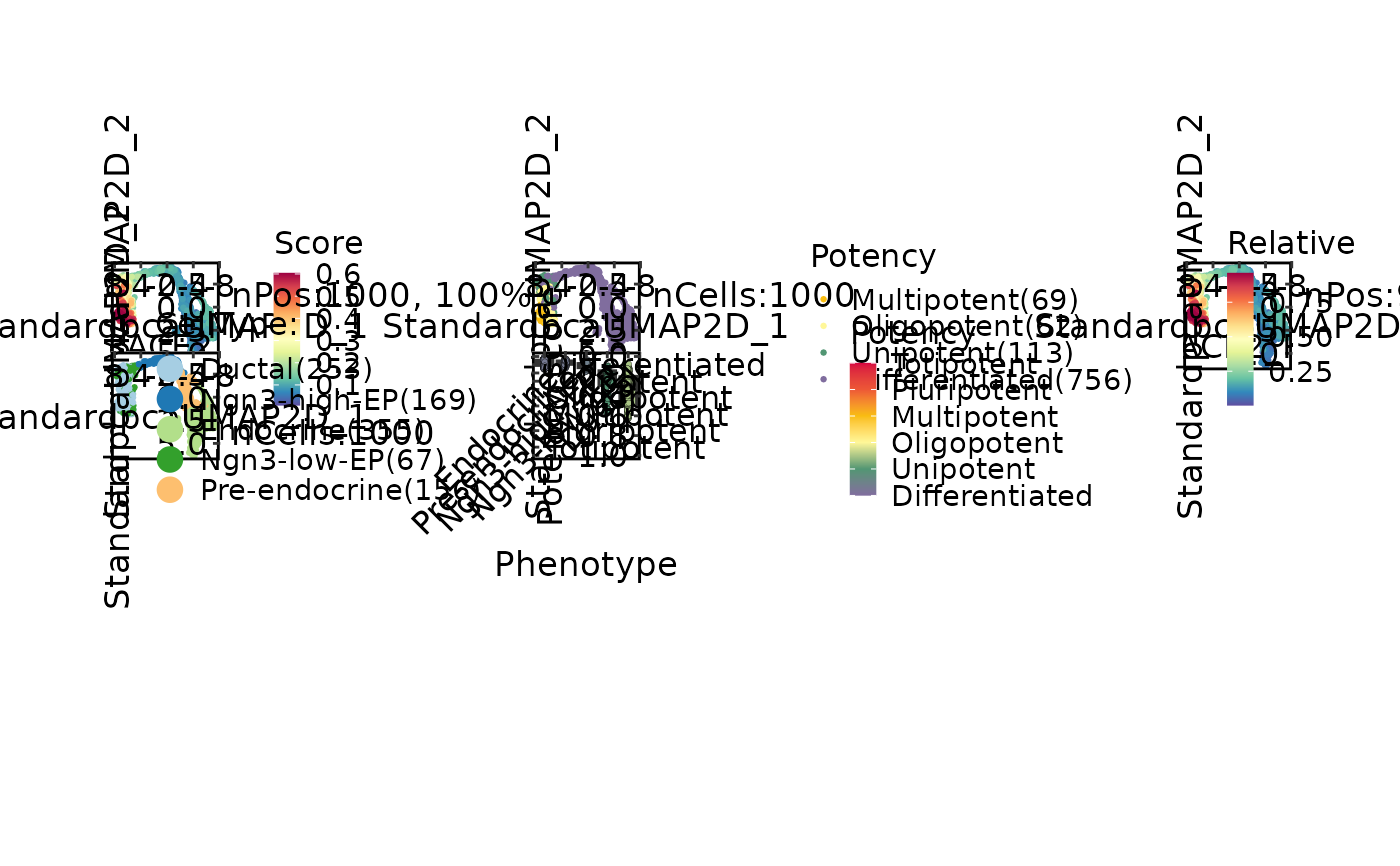
CytoTRACEPlot(
  pancreas_sub,
  xlab = "UMAP_1",
  ylab = "UMAP_2",
  ncol = 2
)