Create a `giotto2` object from a Seurat object. The converter is SCT-aware: raw counts remain the default Giotto input, while SCT normalized values are optionally added as an extra Giotto expression layer. The input Seurat object is not modified.
Arguments
- srt
A Seurat object.
- assay
Which assay to use. If
NULL, the default assay of the Seurat object will be used. When the object also containsChromatinAssay, the default assay and additionalChromatinAssaywill be preprocessed sequentially.- layer
Assay layer used as the expression matrix.
- sct.assay
Name of the SCT assay.
- use_sct
How to handle SCT data. `"auto"` keeps counts as the main Giotto expression and records SCT availability. `"none"` ignores SCT. `"normalized"` adds SCT normalized values as an additional expression layer.
- image
Name of the Seurat spatial image used by the spatial workflow. If
NULL, the first image is used when present.- coord.cols
Metadata coordinate columns used by the spatial workflow when no image is available.
- features
Features used for PCA and clustering. If
NULL, current variable features are used, falling back to all assay features.- conversion_params
Additional parameters passed to
Giotto::createGiottoObject().- use_official
Whether to try `Giotto::seuratToGiottoV5()` before falling back to the scop-controlled converter.
- verbose
Whether to print the message. Default is
TRUE.- seed
Random seed for reproducibility. Default is
11.
Examples
data(visium_human_pancreas_sub)
spatial <- visium_human_pancreas_sub
g <- structure(
list(
giotto = list(
umap = cbind(
UMAP_1 = as.numeric(scale(spatial$x)),
UMAP_2 = as.numeric(scale(spatial$y))
)
),
source = list(
cells = colnames(spatial),
features = rownames(spatial),
coordinates = data.frame(
cell_ID = colnames(spatial),
sdimx = spatial$x,
sdimy = spatial$y
)
),
results = list(
cluster = list(
table = data.frame(
cluster = paste0("cluster_", (seq_len(ncol(spatial)) - 1) %% 3 + 1),
row.names = colnames(spatial)
)
),
spatial_network = list(
table = data.frame(
from = colnames(spatial)[1:8],
to = colnames(spatial)[2:9]
)
)
),
active = "cluster"
),
class = c("giotto2", "list")
)
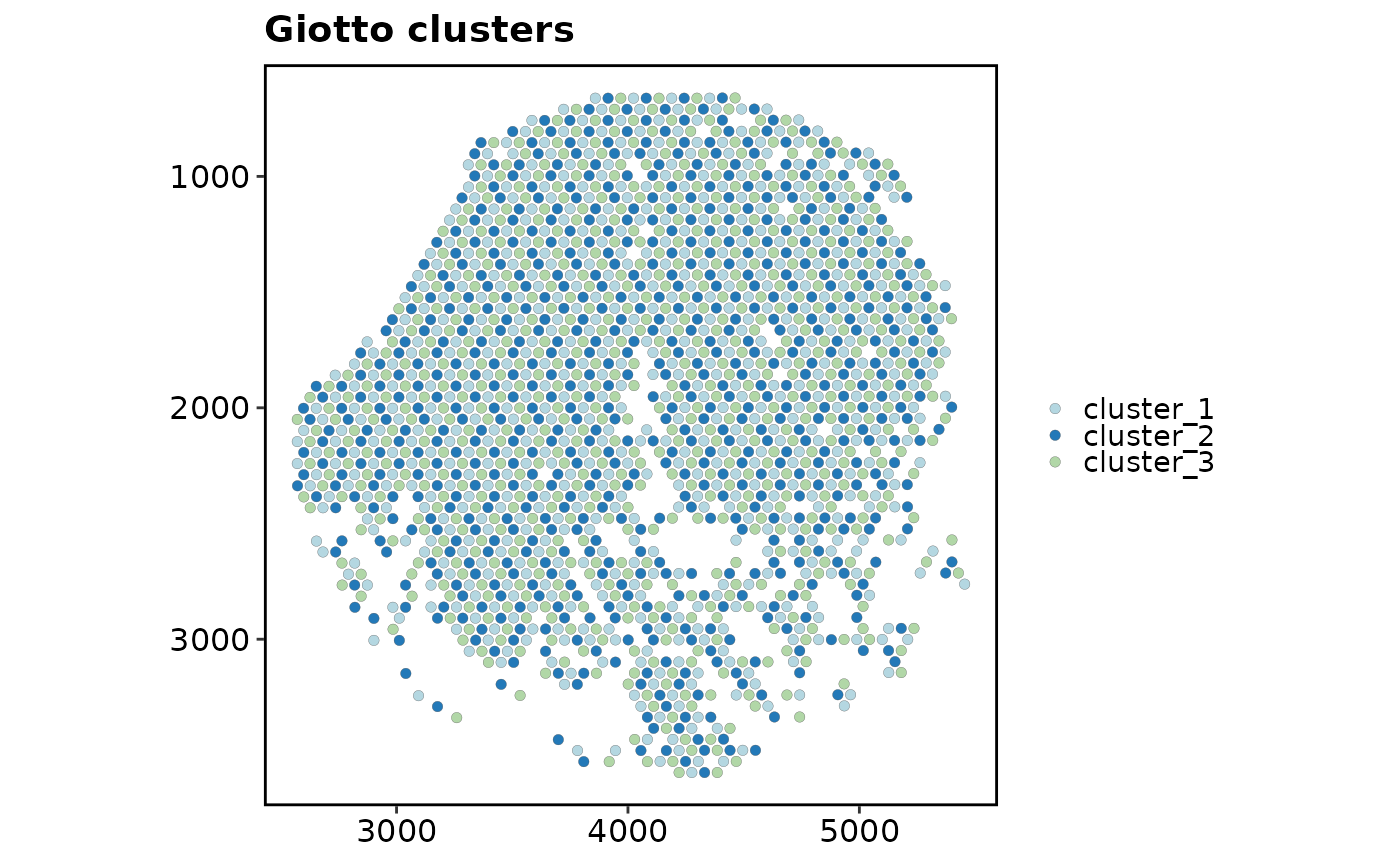
GiottoPlot(g, plot_type = "cluster")
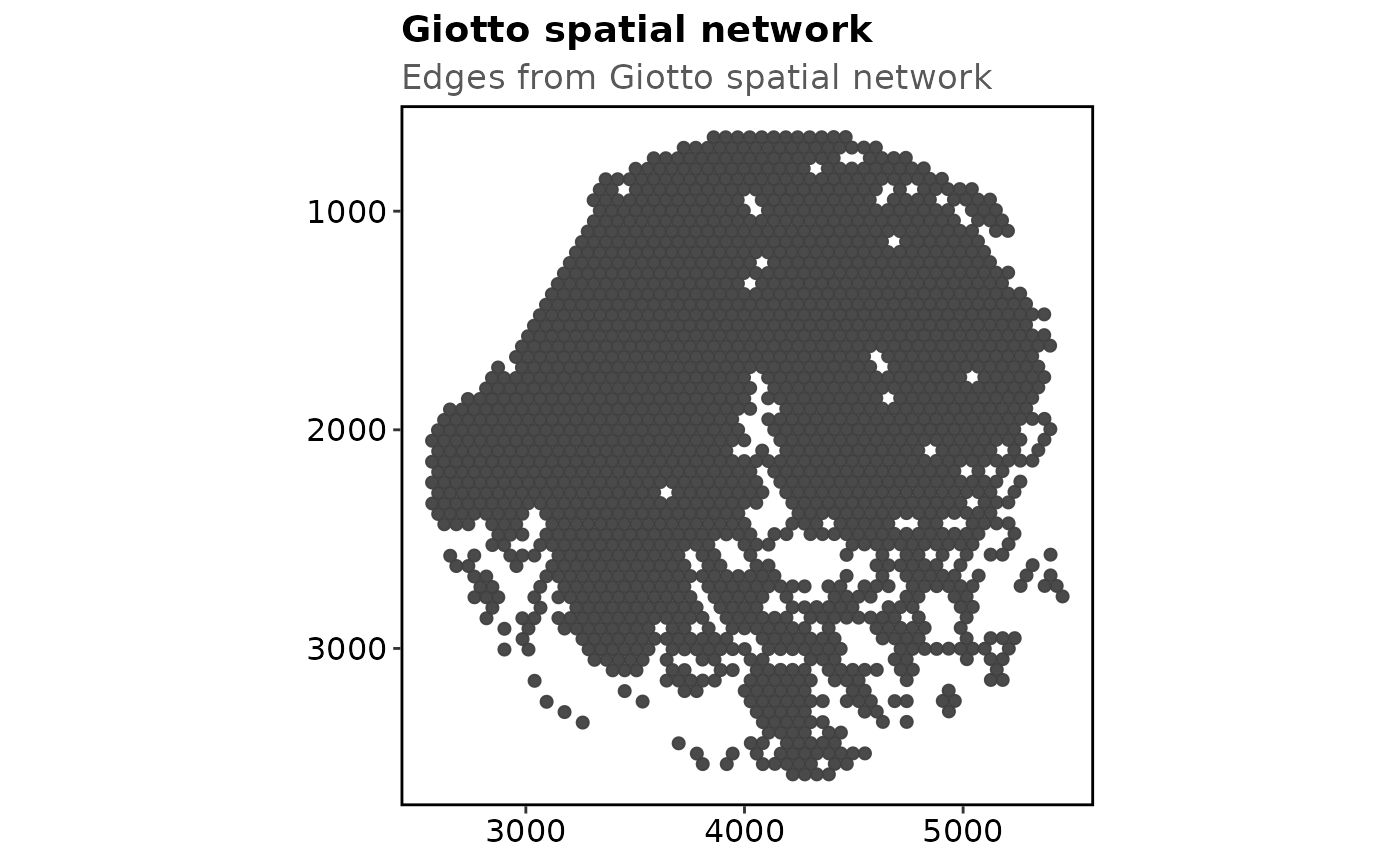
 GiottoPlot(g, plot_type = "network")
 if (
isTRUE(check_r("giotto-suite/Giotto", verbose = FALSE))
) {
g <- SeuratToScopGiotto(
spatial,
assay = "Spatial",
layer = "counts",
coord.cols = c("x", "y"),
verbose = FALSE
)
}
#> Error in check_r("giotto-suite/Giotto", verbose = FALSE): could not find function "check_r"
if (
isTRUE(check_r("giotto-suite/Giotto", verbose = FALSE))
) {
g <- SeuratToScopGiotto(
spatial,
assay = "Spatial",
layer = "counts",
coord.cols = c("x", "y"),
verbose = FALSE
)
}
#> Error in check_r("giotto-suite/Giotto", verbose = FALSE): could not find function "check_r"