Run spatial gradient feature screening
Source:R/RunSpatialGradientFeatures.R
RunSpatialGradientFeatures.RdScreen features for expression trends along a spatial trajectory or with distance from annotated regions.
Usage
RunSpatialGradientFeatures(
  object,
  reference = c("trajectory", "annotation"),
  backend = "cpp",
  result_name = NULL,
  assay = NULL,
  layer = "data",
  variables = NULL,
  image = NULL,
  coord.cols = c("x", "y"),
  start = NULL,
  end = NULL,
  traj_df = NULL,
  annotation.by = NULL,
  annotation.groups = NULL,
  annotation.variable = NULL,
  annotation.threshold = NULL,
  unit = NULL,
  sign_var = "fdr",
  sign_threshold = 0.05,
  n_random = 10000,
  seed = 123,
  n_bins = 50,
  min_spots = 3,
  nfeatures = 2000,
  set_variable_features = FALSE,
  store_results = TRUE,
  verbose = TRUE,
  coordinate_space = c("raw", "legacy_display"),
  srt = NULL
)
Arguments
- object
A
Seuratobject.- reference
Spatial reference type:
"trajectory"for STS or"annotation"for SAS.- backend
Computation backend. The supported backend is
"cpp", which uses the compiled native spatial implementation.- result_name
Name used to store this result. If
NULL, a name is generated fromreference.- assay
Assay to use.
NULLuses the default assay.- layer
Assay layer used for expression values.
- variables
Numeric variables or genes tested by the native backend. If
NULL,srt@tools[["SpatialVariableFeatures"]]is used first, then variable features, then all assay features.- image
Spatial image name. Required when multiple images are present; a single image is selected automatically when
NULL.- coord.cols
Metadata coordinate columns used by the
"cpp"backend when no image coordinates are available.- start, end, traj_df
Trajectory geometry used by the native backend when
reference = "trajectory".- annotation.by, annotation.groups
Metadata grouping used to create the native annotation mask.
- annotation.variable, annotation.threshold
Numeric variable and threshold used to create a native numeric annotation mask. Numeric thresholds are interpreted as
">{threshold}".- unit
Optional coordinate-unit label stored in the result source. It does not transform coordinates.
- sign_var, sign_threshold
Column and cutoff used to select top gradient variables from the native significance table.
- n_random, seed
Permutation count and random seed used by the native screening backend.
- n_bins
Number of distance bins used for the
"cpp"backend screening curve.- min_spots
Minimum number of non-zero spots required for a variable in the
"cpp"backend.- nfeatures
Number of top gradient variables retained in
top_variablesand optionally set as Seurat variable features.- set_variable_features
Whether to set top gradient variables as Seurat variable features independently of
store_results. If explicitlyTRUE, an empty selection clears the target assay's variable features.- store_results
Whether to store the normalized result in
srt@tools.- verbose
Whether to print the message. Default is
TRUE.- coordinate_space
Coordinate system used by the C++ distance calculations. The default is raw acquisition coordinates, so
start,end, trajectory positions, and C++ distances share raw coordinate units. Use"legacy_display"explicitly for pre-0.9.0 display coordinates. Results retain the raw coordinate units used by the native backend.- srt
Deprecated alias for
object; supply exactly one of the two. It will be removed in scop 1.0.0.
Value
A Seurat object. When store_results = TRUE, spatial gradient
screening results are stored in srt@tools[["SpatialGradientFeatures"]].
Otherwise existing stored results are unchanged. Variable features are
independently updated only when set_variable_features = TRUE.
Details
The current native interface is intentionally small. Older calls that pass
sample_name, platform, img_scale_fct, assay_modality,
trajectory_id, width, annotation_id, core, distance,
angle_span, resolution, model_add, model_subset, model_remove,
control, or annotation_ids now fail as unused arguments. Use image,
coord.cols, and coordinate_space for coordinate selection; use
annotation.by/annotation.groups or
annotation.variable/annotation.threshold for annotation references;
and use n_random, n_bins, min_spots, sign_threshold, and
nfeatures for native screening controls.
Examples
data(visium_human_pancreas_sub)
spatial <- visium_human_pancreas_sub
counts <- GetAssayData5(spatial, assay = "Spatial", layer = "counts")
gradient_features <- names(sort(Matrix::rowSums(counts), decreasing = TRUE))[
seq_len(min(8L, nrow(counts)))
]
# Use a diagonal example axis without permutation testing.
spatial <- RunSpatialGradientFeatures(
spatial,
reference = "trajectory",
backend = "cpp",
result_name = "example_axis",
variables = gradient_features,
start = c(min(spatial$x), min(spatial$y)),
end = c(max(spatial$x), max(spatial$y)),
layer = "counts",
coord.cols = c("x", "y"),
n_random = 0,
n_bins = 5,
min_spots = 3,
sign_threshold = 1,
nfeatures = 4,
verbose = FALSE
)
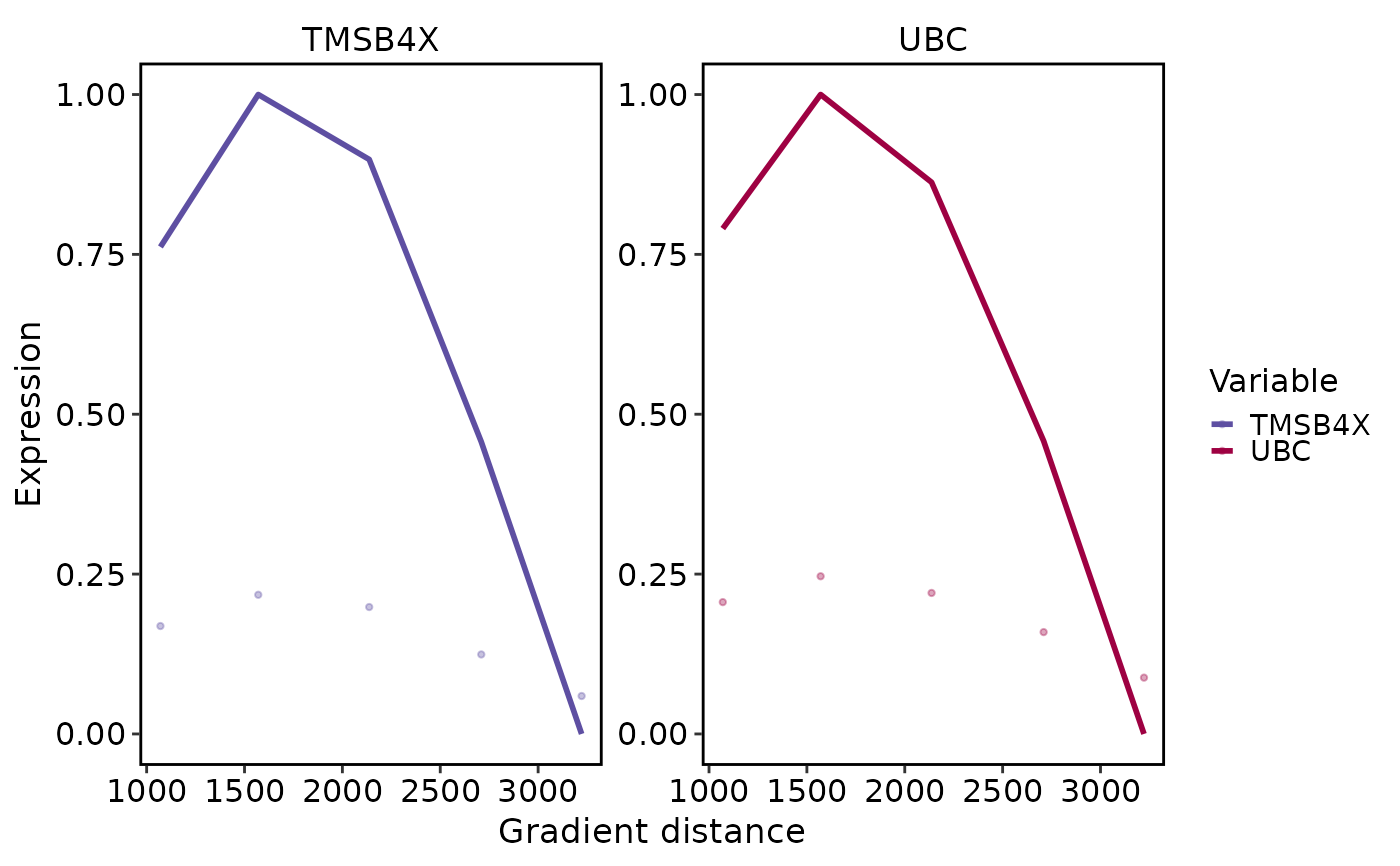
SpatialGradientPlot(spatial, plot_type = "line")
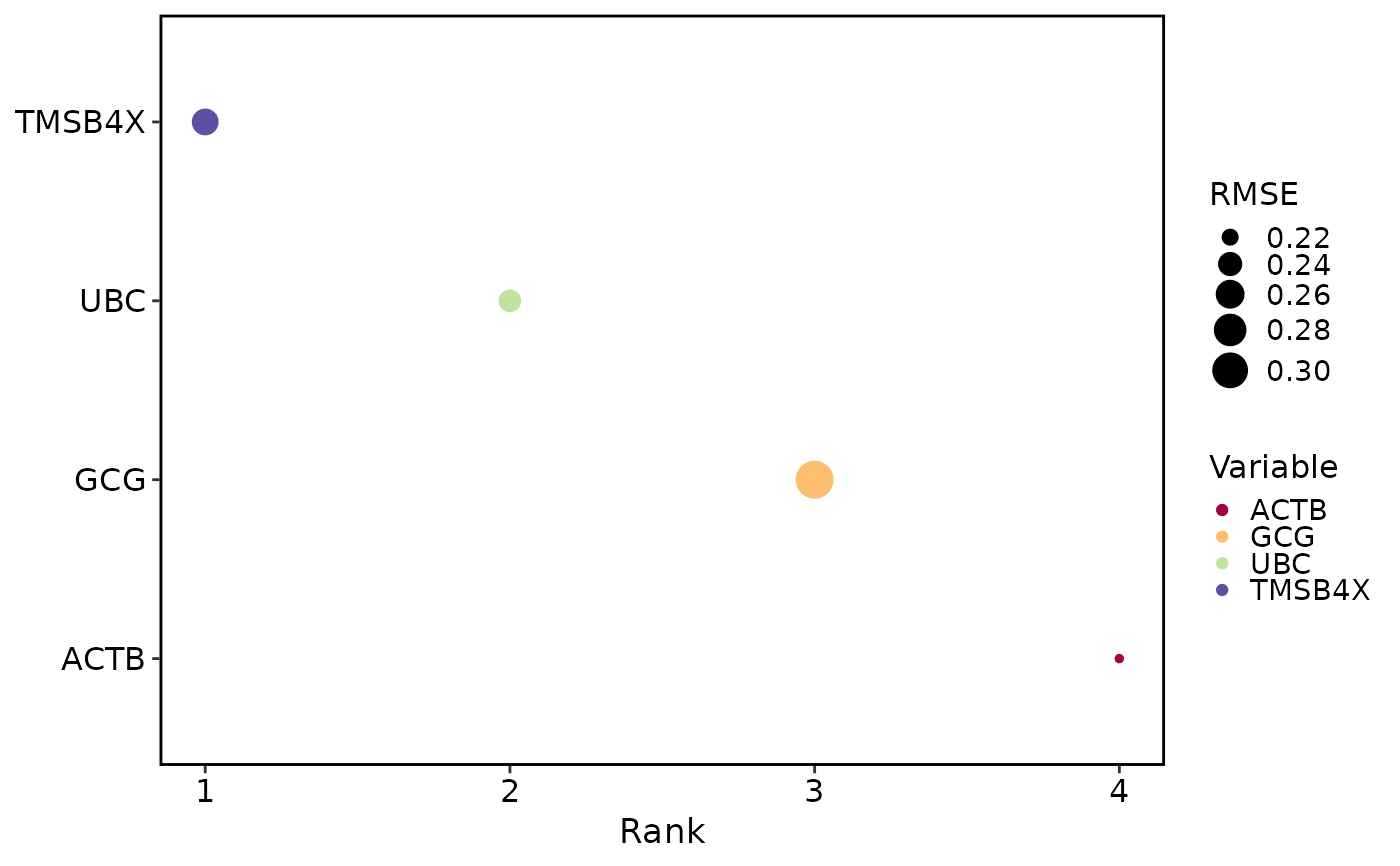 SpatialGradientPlot(spatial, plot_type = "model")