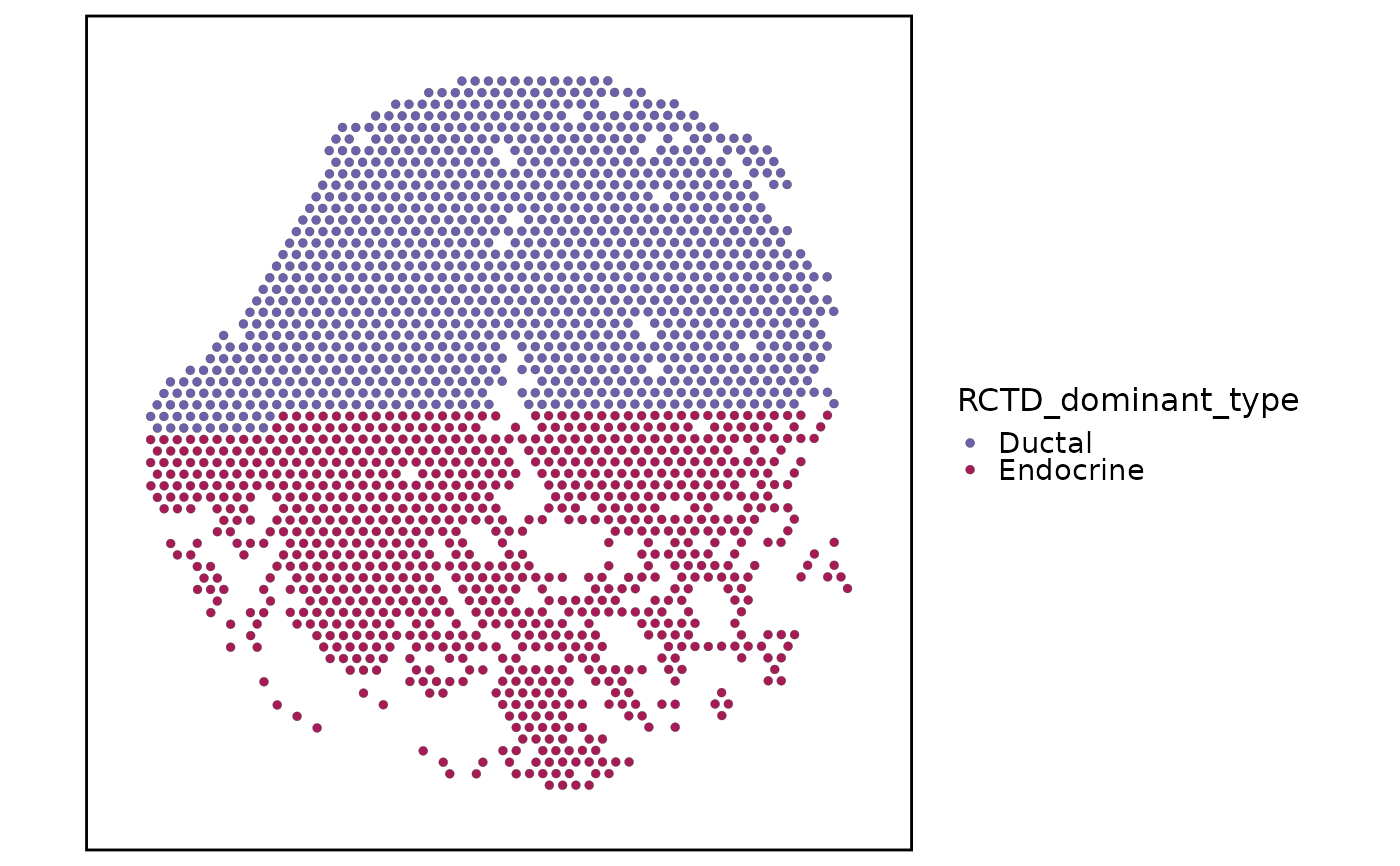
Estimate spot-level cell-type proportions using RCTD and an annotated single-cell reference.
Usage
RunRCTD(
  object,
  reference,
  reference_label = "celltype",
  assay = NULL,
  reference_assay = NULL,
  layer = "counts",
  reference_layer = "counts",
  features = NULL,
  image = NULL,
  coord.cols = c("x", "y"),
  rctd_mode = c("full", "multi", "doublet"),
  max_cores = 1,
  min_cells = 25,
  prefix = "RCTD",
  store_results = TRUE,
  round_counts = TRUE,
  create_rctd_params = list(),
  run_rctd_params = list(),
  verbose = TRUE,
  ...,
  coordinate_space = c("raw", "legacy_display"),
  tool_name = "RCTD",
  srt = NULL
)
Arguments
- object
Spatial
Seuratobject used as the RCTD query.- reference
Reference
Seuratobject containing annotated single cells.- reference_label
Metadata column in
referencewith cell type labels.- assay
Assay used in
object. IfNULL, the default assay is used.- reference_assay
Assay used in
reference. Only cells present in this assay are used, with reference labels aligned by cell ID.- layer, reference_layer
Assay layers used for spatial and reference raw counts.
- features
Features used for RCTD. If
NULL, shared features are used. Total UMI depths are computed from each full selected assay/layer before feature filtering (and after optional count rounding), not from this subset.- image
Name of the Seurat spatial image used to recover coordinates when
coord.colsare not available.- coord.cols
Metadata coordinate columns used when no image coordinate source is requested or available.
- rctd_mode
RCTD mode passed to
spacexr."full"is the default for Visium spot deconvolution.- max_cores
Number of cores passed to
spacexr.- min_cells
Minimum number of reference cells required for each cell type after selected-assay alignment and zero-count filtering. Old
spacexrRCTD requires at least 25 cells per type.- prefix
Prefix for metadata columns.
- store_results
Whether to store detailed RCTD results in
srt@tools.- round_counts
Whether to round non-integer values before passing data to
spacexr. RCTD requires integer count matrices; rounding is a compatibility option and does not recover original counts.- create_rctd_params
Additional parameters passed to
spacexr::createRctd()orspacexr::create.RCTD().- run_rctd_params
Additional parameters passed to
spacexr::runRctd()orspacexr::run.RCTD().- verbose
Whether to print the message. Default is
TRUE.- ...
Additional parameters passed to the RCTD run step.
- coordinate_space
Coordinate space used for distance-sensitive input. The default is raw acquisition coordinates, so backend distances use raw coordinate units. Use
"legacy_display"explicitly to reproduce the display-scaled coordinates used before scop 0.9.0.- tool_name
Name used to store the plain result bundle in
srt@tools.- srt
Deprecated alias for
object; supply exactly one of the two. It will be removed in scop 1.0.0.
Value
A Seurat object with RCTD proportion columns in metadata and
dominant cell type summaries. When store_results = TRUE, detailed results
are also stored in srt@tools[[tool_name]].
Examples
data(visium_human_pancreas_sub)
data(panc8_sub)
keep_spots <- unique(round(seq(
  1,
  ncol(visium_human_pancreas_sub),
  length.out = 120
)))
spatial <- visium_human_pancreas_sub[, keep_spots]
# Results are conditional on the three reference cell types used here.
reference <- panc8_sub[, panc8_sub@meta.data[["celltype"]] %in%
  c("ductal", "alpha", "beta")]
reference <- Seurat::FindVariableFeatures(reference, nfeatures = 300, verbose = FALSE)
features_use <- head(intersect(
  SeuratObject::VariableFeatures(reference),
  rownames(spatial)
), 300)
spatial <- RunRCTD(
  object = spatial,
  reference = reference,
  reference_label = "celltype",
  assay = "Spatial",
  reference_assay = "RNA",
  layer = "counts",
  reference_layer = "counts",
  features = features_use,
  coord.cols = c("x", "y"),
  rctd_mode = "full",
  max_cores = 1,
  min_cells = 25,
  prefix = "RCTD",
  verbose = FALSE
)
#> Begin: process_cell_type_info
#> process_cell_type_info: number of cells in reference: 1148
#> process_cell_type_info: number of genes in reference: 97
#>
#> ductal   beta  alpha
#>    237    428    483
#> End: process_cell_type_info
#> create.RCTD: getting regression differentially expressed genes:
#> get_de_genes: ductal found DE genes: 22
#> get_de_genes: beta found DE genes: 4
#> get_de_genes: alpha found DE genes: 1
#> get_de_genes: total DE genes: 27
#> create.RCTD: getting platform effect normalization differentially expressed genes:
#> get_de_genes: ductal found DE genes: 26
#> get_de_genes: beta found DE genes: 7
#> get_de_genes: alpha found DE genes: 2
#> get_de_genes: total DE genes: 35
#> fitBulk: decomposing bulk
#> chooseSigma: using initial Q_mat with sigma =  1
#> Likelihood value: 4605.44465250967
#> Sigma value:  0.84
#> Likelihood value: 4509.24334104243
#> Sigma value:  0.69
#> Likelihood value: 4433.7443755185
#> Sigma value:  0.61
#> Likelihood value: 4402.86433424729
#> Sigma value:  0.53
#> Likelihood value: 4381.61430997094
#> Sigma value:  0.46
#> Likelihood value: 4373.21937275515
#> Sigma value:  0.45
#> Likelihood value: 4372.94033462053
#> Sigma value:  0.45
SpatialDeconvolutionPlot(
  spatial,
  tool_name = "RCTD",
  plot_type = "dominant",
  overlay_image = FALSE,
  coord.cols = c("x", "y")
)