Run NMF
Usage
RunNMF(object, ...)

# S3 method for class 'Seurat'
RunNMF(
  object,
  assay = NULL,
  layer = "data",
  features = NULL,
  nbes = 50,
  nmf.method = "RcppML",
  tol = 1e-05,
  maxit = 100,
  rev.nmf = FALSE,
  ndims.print = 1:5,
  nfeatures.print = 30,
  reduction.name = "nmf",
  reduction.key = "BE_",
  verbose = TRUE,
  seed.use = 11,
  cores = 0,
  ...
)

# S3 method for class 'Assay'
RunNMF(
  object,
  assay = NULL,
  layer = "data",
  features = NULL,
  nbes = 50,
  nmf.method = "RcppML",
  tol = 1e-05,
  maxit = 100,
  rev.nmf = FALSE,
  ndims.print = 1:5,
  nfeatures.print = 30,
  reduction.key = "BE_",
  verbose = TRUE,
  seed.use = 11,
  cores = 0,
  ...
)

# S3 method for class 'Assay5'
RunNMF(
  object,
  assay = NULL,
  layer = "data",
  features = NULL,
  nbes = 50,
  nmf.method = "RcppML",
  tol = 1e-05,
  maxit = 100,
  rev.nmf = FALSE,
  ndims.print = 1:5,
  nfeatures.print = 30,
  reduction.key = "BE_",
  verbose = TRUE,
  seed.use = 11,
  cores = 0,
  ...
)

# Default S3 method
RunNMF(
  object,
  assay = NULL,
  layer = "data",
  nbes = 50,
  nmf.method = "RcppML",
  tol = 1e-05,
  maxit = 100,
  rev.nmf = FALSE,
  ndims.print = 1:5,
  nfeatures.print = 30,
  reduction.key = "BE_",
  verbose = TRUE,
  cores = 0,
  seed.use = 11,
  ...
)
Arguments
- object
An object. This can be a Seurat object, an Assay object, or a matrix-like object.
- ...
Additional arguments passed to RcppML::nmf or NMF::nmf.
- assay
Assay to use.
NULLuses the default assay.- layer
Assay layer to use.
- features
Features used instead of a reduction.
- nbes
The number of basis vectors (components) to be computed.
- nmf.method
The NMF algorithm to be used. Currently supported values are
"RcppML"and"NMF".- tol
The tolerance for convergence (only applicable when nmf.method is
"RcppML").- maxit
The maximum number of iterations for convergence (only applicable when nmf.method is
"RcppML").- rev.nmf
Whether to perform reverse NMF (i.e., transpose the input matrix) before running the analysis.
- ndims.print
The dimensions (number of basis vectors) to print in the output.
- nfeatures.print
The number of features to print in the output.
- reduction.name
Reduction to be stored in the Seurat object.
- reduction.key
The prefix for the column names of the basis vectors.
- verbose
Whether to print the message. Default is
TRUE.- seed.use
Random seed.
- cores
The number of threads to be used in older
RcppMLreleases that expose a global OpenMP thread setter. Newer releases manage their thread count internally.
Examples
data(pancreas_sub)
pancreas_sub <- RunStandardWorkflow(pancreas_sub)
#> ℹ [2026-10-11 23:40:33] Start standard processing workflow...
#> ℹ [2026-10-11 23:40:33] Checking a list of <Seurat>...
#> ! [2026-10-11 23:40:33] Data 1/1 of the `srt_list` is "unknown"
#> ℹ [2026-10-11 23:40:33] Perform `NormalizeData()` with `normalization.method = 'LogNormalize'` on 1/1 of `srt_list`...
#> ℹ [2026-10-11 23:40:33] Perform `FindVariableFeatures()` on 1/1 of `srt_list`...
#> ℹ [2026-10-11 23:40:33] Use the separate HVF from `srt_list`
#> ℹ [2026-10-11 23:40:33] Number of available HVF: 2000
#> ℹ [2026-10-11 23:40:33] Finished check
#> ℹ [2026-10-11 23:40:33] Perform `ScaleData()`
#> ℹ [2026-10-11 23:40:33] Perform pca linear dimension reduction
#> ℹ [2026-10-11 23:40:34] Use stored estimated dimensions 1:23 for Standardpca
#> ℹ [2026-10-11 23:40:34] Perform `Seurat::FindClusters()` with `cluster_algorithm = 'louvain'` and `cluster_resolution = 0.6`
#> ℹ [2026-10-11 23:40:34] Reorder clusters...
#> ℹ [2026-10-11 23:40:34] Skip `log1p()` because `layer = data` is not "counts"
#> ℹ [2026-10-11 23:40:34] Perform umap nonlinear dimension reduction
#> ✔ [2026-10-11 23:40:42] Standard processing workflow completed
pancreas_sub <- RunNMF(pancreas_sub)
#> ℹ [2026-10-11 23:40:42] Running NMF...
#> ℹ BE_ 1
#> ℹ Positive: Ccnd1, Spp1, Mdk, Rps2, Ldha, Pebp1, Cd24a, Dlk1, Krt8, Mgst1
#> ℹ Clu, Gapdh, Eno1, Prdx1, Cldn10, Mif, Cldn7, Npm1, Dbi, Vim
#> ℹ Sox9, Rpl12, Aldh1b1, Rplp1, Wfdc2, Krt18, Tkt, Aldoa, Hspe1, Ptma
#> ℹ Negative: Tmem108, Poc1a, Epn3, Wipi1, Tmcc3, Nhsl1, Fgf12, Plekho1, Tecpr2, Zbtb4
#> ℹ Gm10941, Trf, Man1c1, Hmgcs1, Nipal1, Jam3, Pgap1, Alpl, Kcnip3, Tnr
#> ℹ Gm15915, Rbp2, Cbfa2t2, Sh2d4a, Bbc3, Megf6, Naaladl2, Fam46d, Hist2h2ac, Tox2
#> ℹ BE_ 2
#> ℹ Positive: Spp1, Gsta3, Sparc, Vim, Atp1b1, Mt1, Dbi, Anxa2, Rps2, Id2
#> ℹ Rpl22l1, Rplp1, Mgst1, Clu, Sox9, Cldn6, Mdk, Pdzk1ip1, Bicc1, 1700011H14Rik
#> ℹ Rps12, S100a10, Cldn3, Rpl36a, Ppp1r1b, Adamts1, Serpinh1, Mt2, Ifitm2, Rpl39
#> ℹ Negative: Rpa3, Aacs, Tmem108, Poc1a, Epn3, Wipi1, B830012L14Rik, Tmcc3, Wsb1, Plekho1
#> ℹ Ppp2r2b, Tecpr2, Zbtb4, Haus8, Trf, Gm5420, Man1c1, Hmgcs1, Nipal1, Jam3
#> ℹ Tcerg1, Pgap1, Snrpa1, Alpl, Larp1b, Kcnip3, Tnr, Lsm12, Ptbp3, Gm15915
#> ℹ BE_ 3
#> ℹ Positive: Cck, Mdk, Gadd45a, Neurog3, Selm, Sox4, Btbd17, Tmsb4x, Btg2, Cldn6
#> ℹ Cotl1, Ptma, Jun, Ppp1r14a, Rps2, Ifitm2, Neurod2, Igfbpl1, Gnas, Krt7
#> ℹ Nkx6-1, Aplp1, Ppp3ca, Lrpap1, Rplp1, Hn1, Rps12, Mfng, BC023829, Smarcd2
#> ℹ Negative: Elovl6, Tmem108, Poc1a, Epn3, Nop56, Wipi1, B830012L14Rik, Rrp15, Rfc1, Fgf12
#> ℹ Slc20a1, Ppp2r2b, Lama1, Tecpr2, Zbtb4, Eif1ax, Fam162a, P4ha3, Gm10941, Tenm4
#> ℹ Pde4b, Gm5420, Man1c1, Hmgcs1, Pgap1, Mgst2, Larp1b, Kcnip3, Tnr, Lsm12
#> ℹ BE_ 4
#> ℹ Positive: Spp1, Cyr61, Krt18, Tpm1, Krt8, Myl12a, Vim, Jun, Anxa5, Tnfrsf12a
#> ℹ Csrp1, Sparc, Cldn7, Nudt19, Anxa2, Clu, Myl9, Atp1b1, Cldn3, Tagln2
#> ℹ S100a10, 1700011H14Rik, Cd24a, Rps2, Dbi, Id2, Lurap1l, Rplp1, Myl12b, Klf6
#> ℹ Negative: Rpa3, Elovl6, Aacs, Tmem108, Poc1a, Tmcc3, Rfc1, Plekho1, Slc20a1, Ppp2r2b
#> ℹ Lama1, Tecpr2, Gm10941, Tenm4, Pde4b, Man1c1, Nipal1, Jam3, Pgap1, Alpl
#> ℹ Mgst2, Kcnip3, Tnr, Ptbp3, Gm15915, Cntln, Ocln, Fras1, Rbp2, Cbfa2t2
#> ℹ BE_ 5
#> ℹ Positive: 2810417H13Rik, Rrm2, Hmgb2, Dut, Pcna, Lig1, H2afz, Tipin, Tuba1b, Tk1
#> ℹ Mcm5, Dek, Tyms, Gmnn, Ran, Tubb5, Rfc2, Srsf2, Ranbp1, Orc6
#> ℹ Mcm3, Uhrf1, Gins2, Dnajc9, Mcm6, Siva1, Rfc3, Mcm7, Rpa2, Ptma
#> ℹ Negative: 1110002L01Rik, Aacs, Wipi1, B830012L14Rik, Tmcc3, Trib1, Fgf12, Plekho1, Ppp2r2b, Lama1
#> ℹ Tenm4, Trf, Gm5420, Man1c1, Jam3, Mgst2, Kcnip3, Tnr, Gm15915, Cbfa2t2
#> ℹ Sh2d4a, Bbc3, Fkbp9, Ano6, Prkcb, Megf6, Fam46d, Slc52a3, Ankrd2, Tox2
#> ✔ [2026-10-11 23:40:47] NMF compute completed
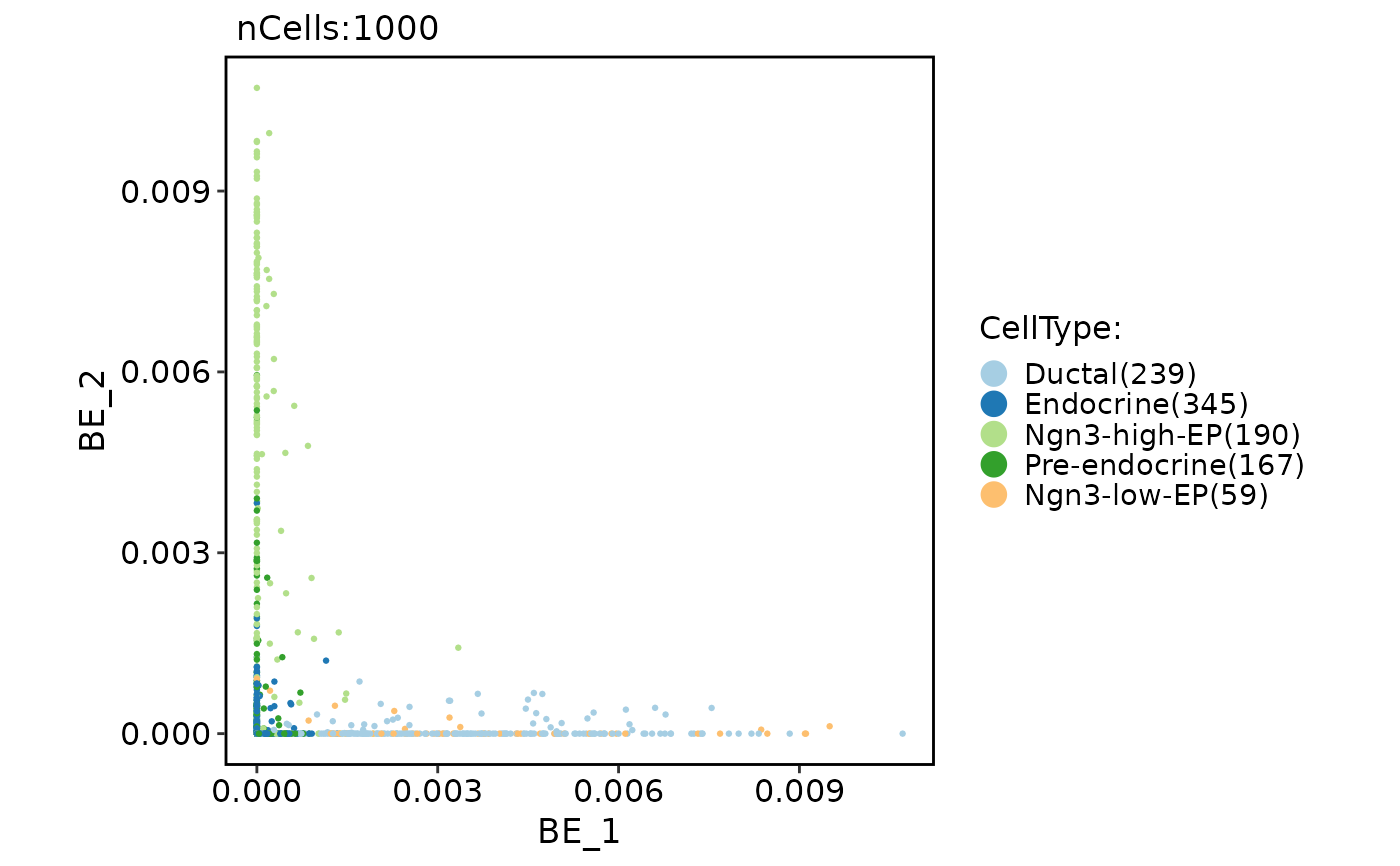
CellDimPlot(
pancreas_sub,
group.by = "CellType",
reduction = "nmf"
)
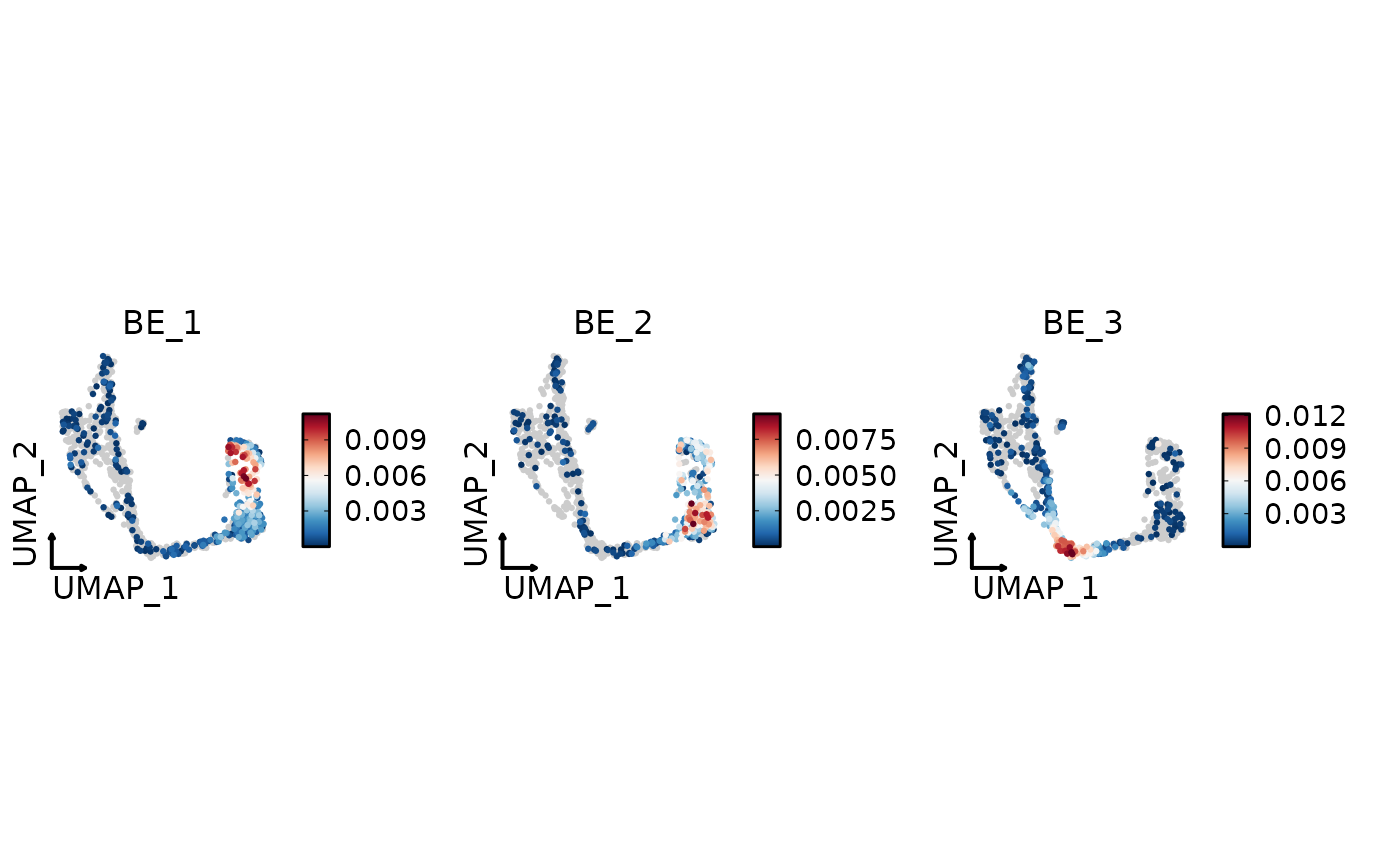
 FeatureDimPlot(
pancreas_sub,
features = c("BE_1", "BE_2", "BE_3"),
reduction = "UMAP",
palette = "RdBu",
xlab = "UMAP_1",
ylab = "UMAP_2",
theme_use = "theme_blank"
)
FeatureDimPlot(
pancreas_sub,
features = c("BE_1", "BE_2", "BE_3"),
reduction = "UMAP",
palette = "RdBu",
xlab = "UMAP_1",
ylab = "UMAP_2",
theme_use = "theme_blank"
)
 ht_cells <- NMFHeatmap(
pancreas_sub,
plot_type = "cells",
cell_annotation = "CellType"
)
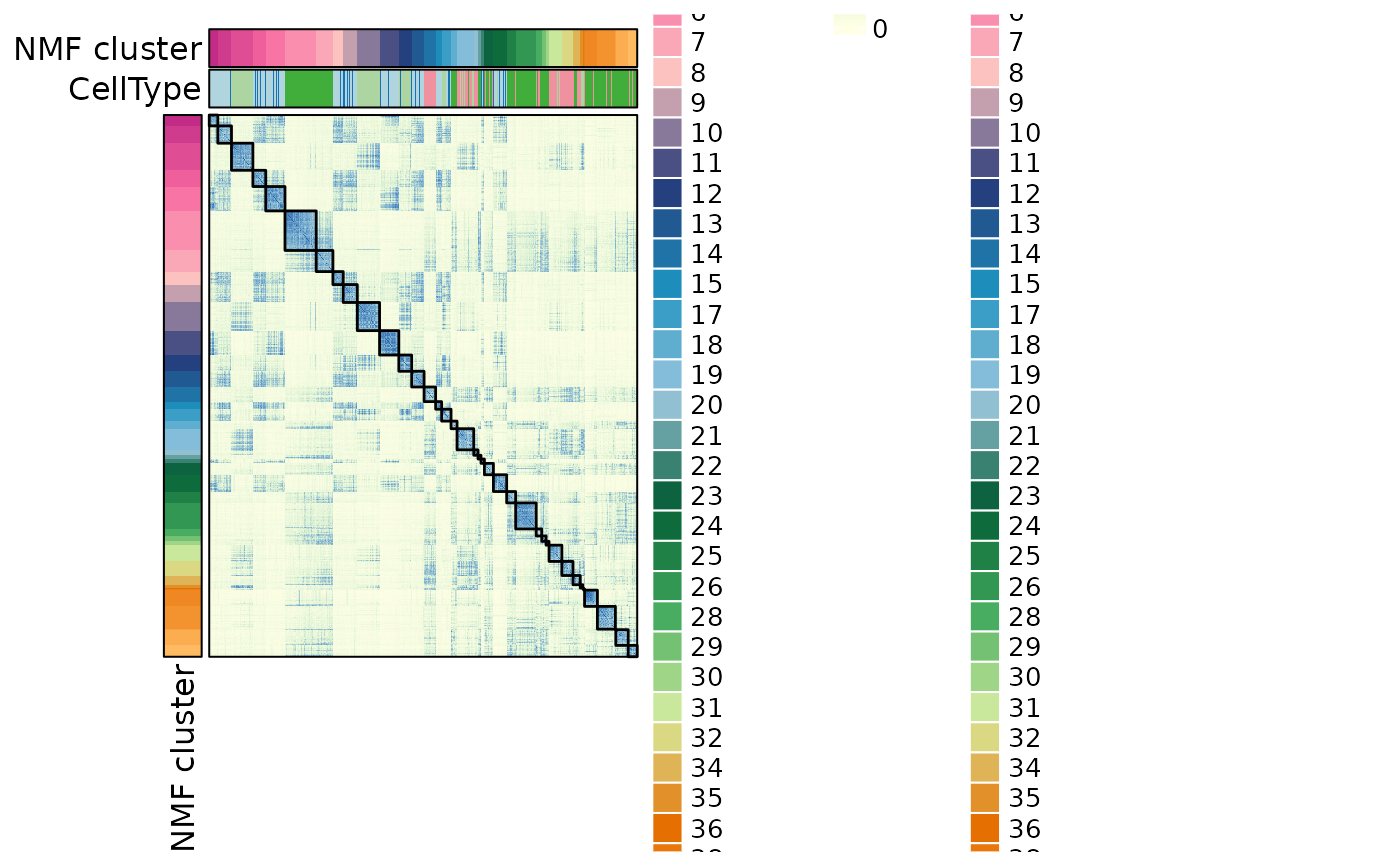
#> ℹ [2026-10-11 23:40:48] `NMFHeatmap()` input: 1000 cells x 50 NMF dimensions. Computing a 1000 x 1000 similarity matrix (~0.01 GiB dense numeric matrix).
#> ℹ [2026-10-11 23:40:48] Ordering `NMFHeatmap()` rows and columns ...
#> ℹ [2026-10-11 23:40:48] Building ComplexHeatmap object for `NMFHeatmap()` ...
#> ℹ [2026-10-11 23:40:48] Calculating `NMFHeatmap()` render size ...
#> ℹ [2026-10-11 23:40:48] Drawing `NMFHeatmap()`; this can take time for large similarity matrices ...
#> ℹ [2026-10-11 23:40:49] Assembling `NMFHeatmap()` plot object ...
ht_cells$plot
ht_cells <- NMFHeatmap(
pancreas_sub,
plot_type = "cells",
cell_annotation = "CellType"
)
#> ℹ [2026-10-11 23:40:48] `NMFHeatmap()` input: 1000 cells x 50 NMF dimensions. Computing a 1000 x 1000 similarity matrix (~0.01 GiB dense numeric matrix).
#> ℹ [2026-10-11 23:40:48] Ordering `NMFHeatmap()` rows and columns ...
#> ℹ [2026-10-11 23:40:48] Building ComplexHeatmap object for `NMFHeatmap()` ...
#> ℹ [2026-10-11 23:40:48] Calculating `NMFHeatmap()` render size ...
#> ℹ [2026-10-11 23:40:48] Drawing `NMFHeatmap()`; this can take time for large similarity matrices ...
#> ℹ [2026-10-11 23:40:49] Assembling `NMFHeatmap()` plot object ...
ht_cells$plot
 ht_features <- NMFHeatmap(
pancreas_sub,
plot_type = "features"
)
#> ℹ [2026-10-11 23:40:50] `NMFHeatmap()` input: 2000 features x 50 NMF dimensions. Computing a 2000 x 2000 similarity matrix (~0.03 GiB dense numeric matrix).
#> ℹ [2026-10-11 23:40:50] Ordering `NMFHeatmap()` rows and columns ...
#> ℹ [2026-10-11 23:40:50] Building ComplexHeatmap object for `NMFHeatmap()` ...
#> ℹ [2026-10-11 23:40:50] Calculating `NMFHeatmap()` render size ...
#> ℹ [2026-10-11 23:40:50] Drawing `NMFHeatmap()`; this can take time for large similarity matrices ...
#> ℹ [2026-10-11 23:40:55] Assembling `NMFHeatmap()` plot object ...
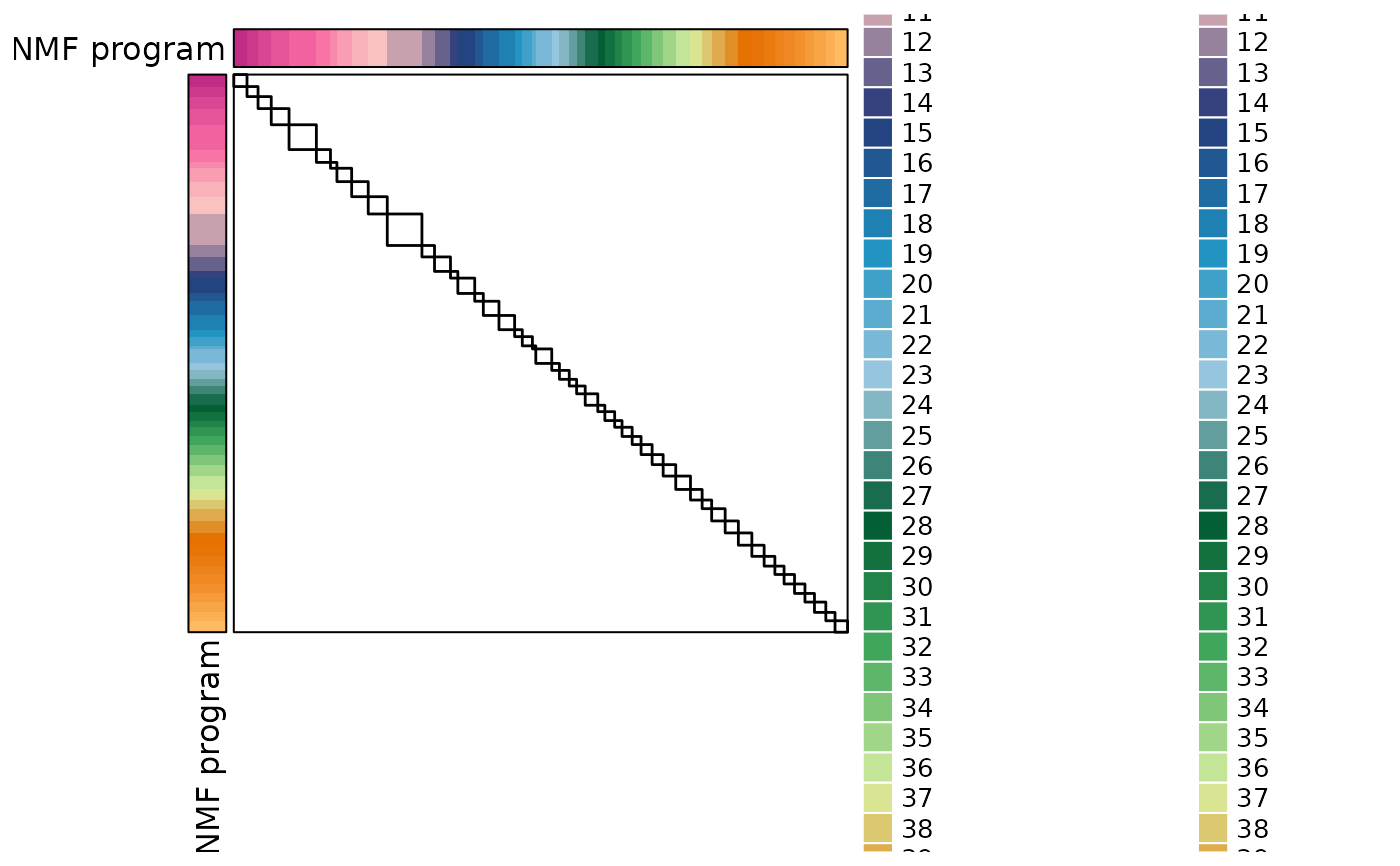
ht_features$plot
ht_features <- NMFHeatmap(
pancreas_sub,
plot_type = "features"
)
#> ℹ [2026-10-11 23:40:50] `NMFHeatmap()` input: 2000 features x 50 NMF dimensions. Computing a 2000 x 2000 similarity matrix (~0.03 GiB dense numeric matrix).
#> ℹ [2026-10-11 23:40:50] Ordering `NMFHeatmap()` rows and columns ...
#> ℹ [2026-10-11 23:40:50] Building ComplexHeatmap object for `NMFHeatmap()` ...
#> ℹ [2026-10-11 23:40:50] Calculating `NMFHeatmap()` render size ...
#> ℹ [2026-10-11 23:40:50] Drawing `NMFHeatmap()`; this can take time for large similarity matrices ...
#> ℹ [2026-10-11 23:40:55] Assembling `NMFHeatmap()` plot object ...
ht_features$plot