Run MDS (multi-dimensional scaling)
Usage
RunMDS(object, ...)

# S3 method for class 'Seurat'
RunMDS(
  object,
  assay = NULL,
  layer = "data",
  features = NULL,
  nmds = 50,
  dist.method = "euclidean",
  mds.method = "cmdscale",
  rev.mds = FALSE,
  reduction.name = "mds",
  reduction.key = "MDS_",
  verbose = TRUE,
  seed.use = 11,
  ...
)

# S3 method for class 'Assay'
RunMDS(
  object,
  assay = NULL,
  layer = "data",
  features = NULL,
  nmds = 50,
  dist.method = "euclidean",
  mds.method = "cmdscale",
  rev.mds = FALSE,
  reduction.key = "MDS_",
  verbose = TRUE,
  seed.use = 11,
  ...
)

# S3 method for class 'Assay5'
RunMDS(
  object,
  assay = NULL,
  layer = "data",
  features = NULL,
  nmds = 50,
  dist.method = "euclidean",
  mds.method = "cmdscale",
  rev.mds = FALSE,
  reduction.key = "MDS_",
  verbose = TRUE,
  seed.use = 11,
  ...
)

# Default S3 method
RunMDS(
  object,
  assay = NULL,
  layer = "data",
  nmds = 50,
  dist.method = "euclidean",
  mds.method = "cmdscale",
  rev.mds = FALSE,
  reduction.key = "MDS_",
  verbose = TRUE,
  seed.use = 11,
  ...
)
Arguments
- object
An object. This can be a Seurat object, an assay object, or a matrix-like object.
- ...
Passed to stats::cmdscale, MASS::isoMDS or MASS::sammon.
- assay
Assay to use.
NULLuses the default assay.- layer
Assay layer to use.
- features
Features used instead of a reduction.
- nmds
The number of dimensions to be computed.
- dist.method
The distance metric to be used. Currently supported values are
"euclidean","chisquared","kullback","jeffreys","jensen","manhattan","maximum","canberra","minkowski", and"hamming".- mds.method
The MDS algorithm to be used. Currently supported values are
"cmdscale","isoMDS", and"sammon".- rev.mds
Whether to perform reverse MDS (i.e., transpose the input matrix) before running the analysis.
- reduction.name
Reduction to be stored in the Seurat object.
- reduction.key
The prefix for the column names of the basis vectors.
- verbose
Whether to print the message. Default is
TRUE.- seed.use
Random seed.
Examples
data(pancreas_sub)
pancreas_sub <- RunStandardWorkflow(pancreas_sub)
#> ℹ [2026-10-11 23:39:55] Start standard processing workflow...
#> ℹ [2026-10-11 23:39:55] Checking a list of <Seurat>...
#> ! [2026-10-11 23:39:55] Data 1/1 of the `srt_list` is "unknown"
#> ℹ [2026-10-11 23:39:55] Perform `NormalizeData()` with `normalization.method = 'LogNormalize'` on 1/1 of `srt_list`...
#> ℹ [2026-10-11 23:39:55] Perform `FindVariableFeatures()` on 1/1 of `srt_list`...
#> ℹ [2026-10-11 23:39:55] Use the separate HVF from `srt_list`
#> ℹ [2026-10-11 23:39:55] Number of available HVF: 2000
#> ℹ [2026-10-11 23:39:55] Finished check
#> ℹ [2026-10-11 23:39:55] Perform `ScaleData()`
#> ℹ [2026-10-11 23:39:55] Perform pca linear dimension reduction
#> ℹ [2026-10-11 23:39:56] Use stored estimated dimensions 1:23 for Standardpca
#> ℹ [2026-10-11 23:39:56] Perform `Seurat::FindClusters()` with `cluster_algorithm = 'louvain'` and `cluster_resolution = 0.6`
#> ℹ [2026-10-11 23:39:56] Reorder clusters...
#> ℹ [2026-10-11 23:39:56] Skip `log1p()` because `layer = data` is not "counts"
#> ℹ [2026-10-11 23:39:56] Perform umap nonlinear dimension reduction
#> ✔ [2026-10-11 23:40:04] Standard processing workflow completed
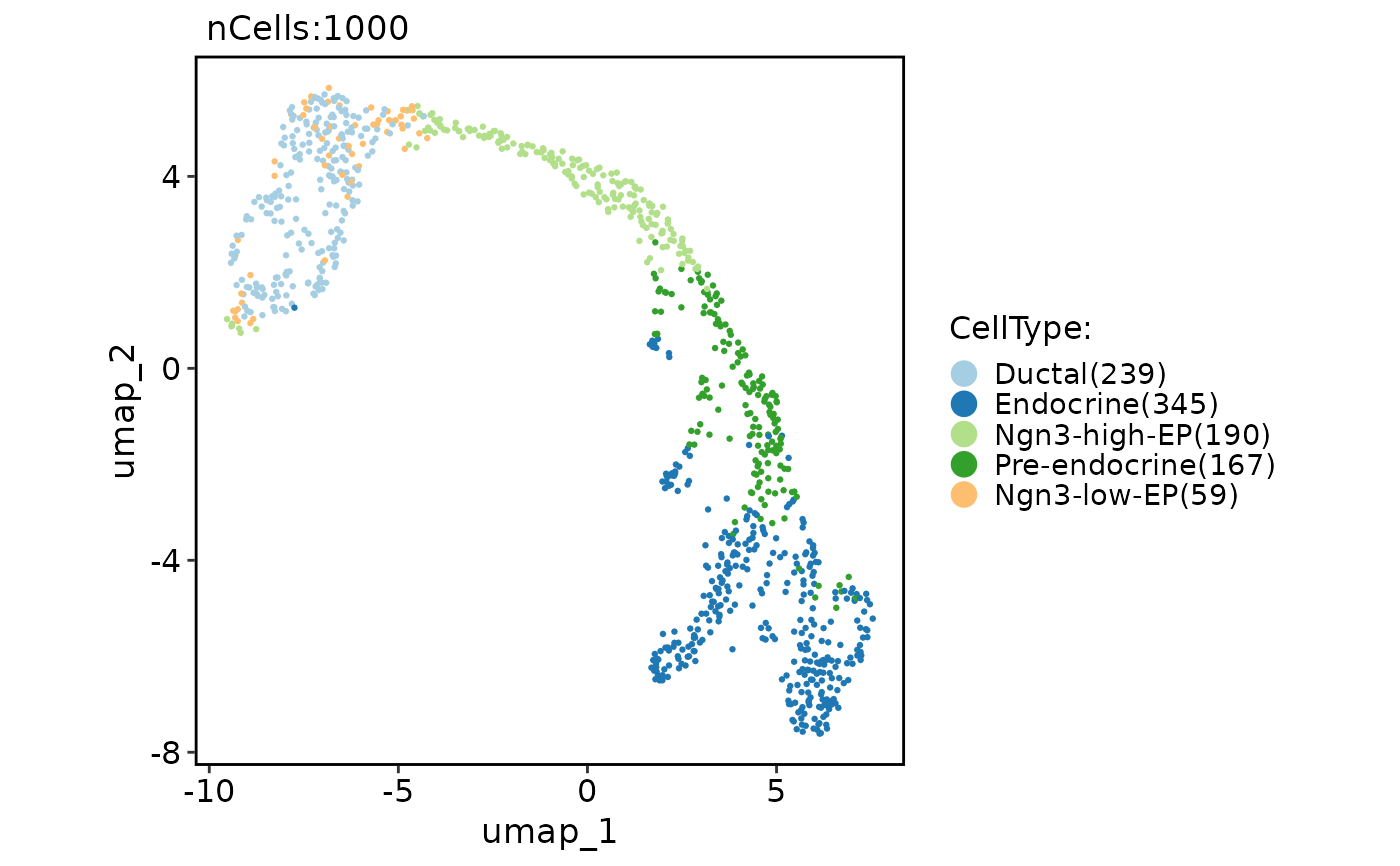
pancreas_sub <- RunMDS(pancreas_sub)
CellDimPlot(
  pancreas_sub,
  group.by = "CellType",
  reduction = "mds"
)